

Non-surgical treatment for submental fat, loose neck skin, jawline laxity and lower-face profile balancing
At Skin and Scar Care Clinic, we offer medical-grade treatments for double chin, turkey neck, loose neck skin, submental fullness and jawline definition.
A double chin or turkey neck can make the lower face look heavier, older or less defined. In many clients, the concern is not just fat under the chin. It may be caused by a combination of skin laxity, neck bands, weak chin projection, jawline sagging, weight changes, ageing, genetics or posture.
Our treatment options may include:
- Endolift® for double chin, jawline and neck tightening
- HIFU in selected mild cases
- Chin dermal filler for profile balancing and chin projection
- CO₂ laser for neck wrinkles, crepey skin and skin quality
- Erbium Glass laser for gradual collagen stimulation
- Bio Remodelling / Bio Stimulator or skin bioremodelling injections
- Anti-wrinkle injections for platysma bands in selected clients
- Fat-dissolving injections in carefully selected cases
- Surgical referral where non-surgical treatment is unlikely to achieve the desired result
Our approach is personalised, safety-led and focused on natural lower-face rejuvenation.
What is a double chin?
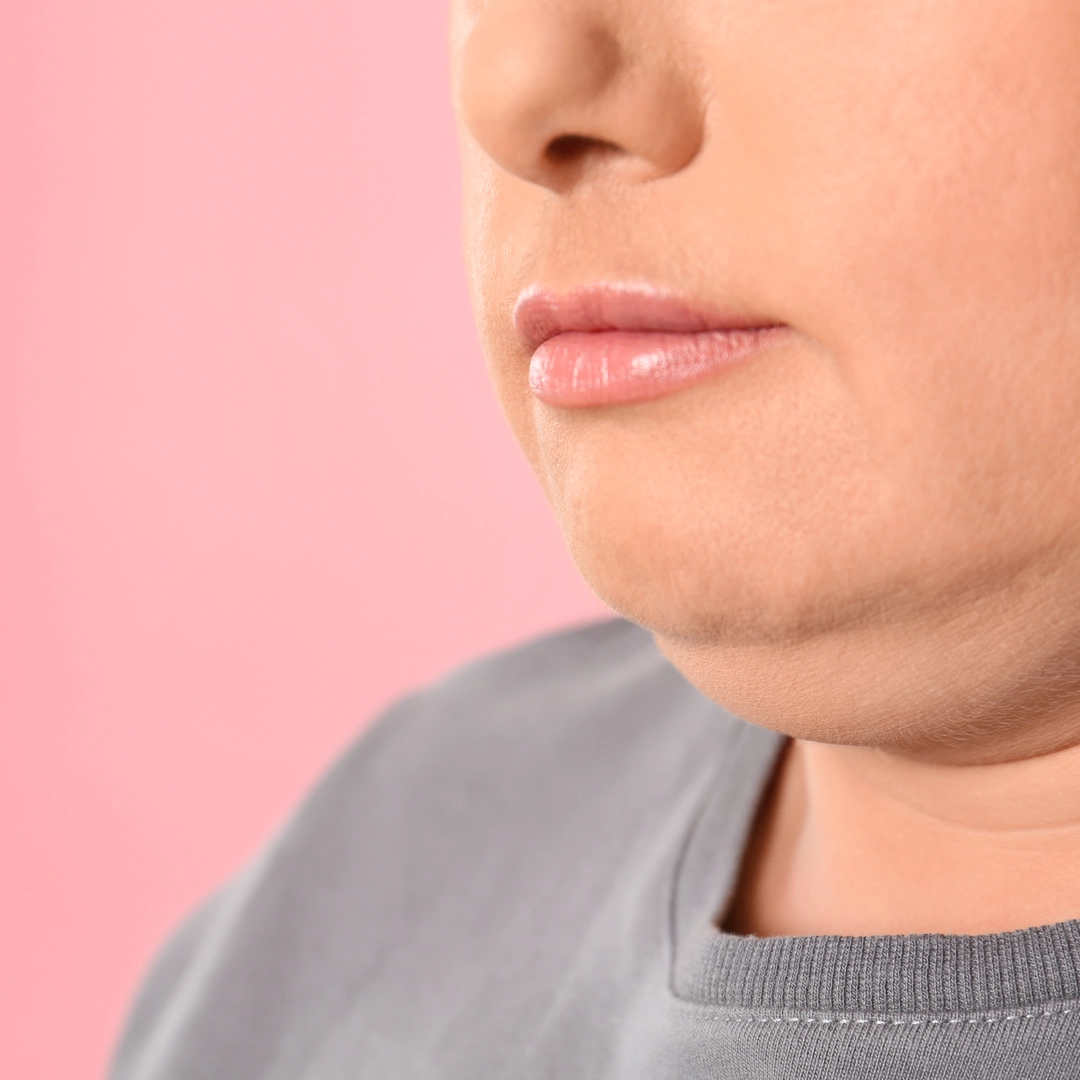
A double chin refers to fullness under the chin, also known as submental fullness.
It may appear as:
- Fat under the chin
- Soft fullness below the jawline
- Poor jawline definition
- A heavy side profile
- Neck fullness
- Blurring between the chin and neck
- Reduced cervicomental angle
- A shorter or less defined neck appearance
A double chin can be caused by fat, but it can also be made worse by loose skin, weak chin projection or poor jawline support.
What is turkey neck?
Turkey neck describes loose, sagging, wrinkled or crepey skin around the neck.
It may appear as:
- Loose hanging neck skin
- Neck wrinkles
- Crepey skin texture
- Vertical neck bands
- Sagging under the chin
- Poor neck definition
- Skin folds under the jawline
- Age-related laxity
Turkey neck is usually caused more by skin laxity and collagen loss than fat alone.
Why do double chin and turkey neck happen?
1. Submental fat
Some clients naturally store fat under the chin, even if they are otherwise slim. This can be genetic or related to weight gain.
Submental fat can soften the jawline and make the neck look less defined.
2. Skin laxity
Loose skin under the chin and neck is one of the main causes of turkey neck. It may happen due to ageing, collagen loss, weight loss or sun damage.
3. Weak chin projection
A small or recessed chin can make the neck look fuller, even when there is not much fat.
When the chin sits slightly behind the ideal facial profile, the lower face may look less supported and the neck may look shorter or heavier.
This is why chin assessment is essential in double chin treatment.
4. Jawline laxity and jowls
Sagging along the jawline can blend into the upper neck, making the double chin or turkey neck look worse.
5. Weight loss
Significant weight loss, including weight loss related to Mounjaro®, Ozempic® or other weight-loss journeys, can leave loose neck skin and lower-face laxity.
6. Ageing and collagen loss
As collagen and elastin reduce, the neck skin becomes thinner and less firm. This can create wrinkles, crepiness and sagging.
7. Platysma bands
The platysma muscle is a thin sheet-like muscle in the neck. With ageing, vertical bands can become more visible and contribute to a turkey neck appearance.
8. Genetics
Some people develop a double chin, weak jawline or loose neck skin earlier due to inherited facial structure or skin quality.
9. Posture and lifestyle
Forward head posture, sun exposure, smoking, dehydration and lack of skincare can contribute to neck lines and loss of definition.
Why proper assessment matters
A double chin is not always treated by removing fat. Turkey neck is not always treated by tightening skin alone.
At Skin and Scar Care Clinic, we assess:
- Submental fat
- Neck skin laxity
- Jawline definition
- Chin projection
- Chin-to-neck angle
- Jowls
- Platysma bands
- Skin quality and wrinkles
- Previous treatments
- Weight changes
- Medical history
- Whether non-surgical treatment or surgery is most appropriate
The best results often come from treating the right combination of fat, skin, structure and profile balance.
Endolift® for double chin and turkey neck
Our main non-surgical treatment for submental contouring and neck tightening
Endolift® is one of our key treatments for double chin, jawline laxity and turkey neck.
It is a minimally invasive laser treatment that works beneath the skin using a very fine fibre. The laser energy is delivered under the skin to stimulate tissue contraction, collagen remodelling and selected fat reduction.
Endolift® may help improve:
- Double chin
- Submental fat
- Loose skin under the chin
- Turkey neck
- Jawline laxity
- Jowls
- Neck laxity
- Lower-face heaviness
- Skin tightening
- Chin and neck contour
- Post-weight-loss laxity
Endolift® is particularly useful where there is a combination of mild to moderate fat and skin laxity.
How Endolift® works
Endolift® works from the inside out.
A fine laser fibre is placed under the skin. The laser energy can help:
- Tighten the tissue internally
- Stimulate new collagen
- Improve skin firmness
- Reduce selected superficial fat
- Improve jawline definition
- Improve the chin-to-neck transition
- Support lower-face contouring
The treatment is usually performed under local anaesthetic and does not involve surgical skin removal.
What to expect with Endolift®
After Endolift®, you may experience:
- Swelling
- Bruising
- Tenderness
- Tightness
- Temporary numbness
- Firmness
- Mild lumpiness during healing
- Temporary unevenness as swelling settles
Most clients return to normal daily activities quickly, although swelling and bruising vary from person to person.
Results develop gradually. Some early tightening may be visible within weeks, but the main result usually develops over 3–6 months as collagen remodelling continues.
What Endolift® cannot do
Endolift® is not a surgical neck lift or facelift.
It cannot:
- Remove large amounts of loose skin
- Replace surgical skin excision
- Fully correct severe turkey neck
- Replace liposuction in cases of heavy fat
- Guarantee perfect symmetry
- Create the same lift as surgery
- Correct poor chin projection unless combined with chin support
- If there is severe laxity, heavy neck skin or advanced sagging, surgery may be more appropriate.
HIFU for double chin and neck laxity in selected cases
HIFU, or high-intensity focused ultrasound, is a non-invasive treatment used to stimulate collagen and provide mild tightening.
HIFU may be suitable for selected clients with:
- Mild submental laxity
- Early turkey neck
- Mild jawline softening
- Good skin quality
- Minimal fat
- No significant loose skin
- Preference for a non-invasive treatment
- Realistic expectations
HIFU can be helpful where the main concern is early skin laxity rather than significant fat or loose hanging skin.
When HIFU may not be enough
HIFU may be less suitable if you have:
- Significant double chin fat
- Heavy submental fullness
- Moderate to severe loose skin
- Advanced turkey neck
- Very thin skin with poor support
- Significant jowls
- Previous poor response to HIFU
- Need for a dramatic result
In these cases, Endolift® or surgical assessment may be more appropriate.
Endolift® vs HIFU
Both treatments aim to stimulate collagen and improve tightening, but they work differently.
HIFU
- Non-invasive
- Works from outside the skin
- Best for mild laxity
- Usually minimal downtime
- Results are subtle and gradual
Endolift®
- Minimally invasive
- Works under the skin
- Can target laxity and selected fat
- More suitable for visible double chin and neck laxity
- Results develop over 3–6 months
For many clients with a true double chin or turkey neck, Endolift® may offer a stronger contouring and tightening option than HIFU.
Chin projection and lower-face profile balancing
Why the chin matters in double chin treatment
The chin is one of the most important areas in lower-face rejuvenation.
A weak or recessed chin can make the neck look fuller, even if there is only a small amount of fat. It can also reduce jawline definition and make the lower face look less balanced.
Improving chin projection can help:
- Improve the side profile
- Improve jawline definition
- Improve the chin-to-neck angle
- Make the double chin appear less prominent
- Balance the nose, lips and chin
- Support the lower face
- Create a more elegant profile
This is why we assess the chin in every double chin and turkey neck consultation.
Chin filler for profile balancing
Chin dermal filler can be used to improve chin projection and lower-face balance in suitable clients.
It may help if you have:
- A small or recessed chin
- Mild retrognathia
- Poor side profile
- Weak lower-face support
- Blurred chin-to-neck transition
- Double chin appearance worsened by lack of chin projection
- Mild asymmetry
- Desire for non-surgical profile enhancement
Chin filler does not remove fat. Instead, it improves structure and projection, which can make the lower face and neck look more balanced.
Chin filler and Endolift® combination
For some clients, the best result comes from combining:
- Endolift® to tighten and reduce selected submental fat
- Chin filler to improve projection and profile balance
- CO₂ laser to improve wrinkles and skin quality
This combination can be especially useful when the double chin is caused by both submental fullness and weak chin support.
What chin filler cannot do
Chin filler cannot:
- Remove fat under the chin
- Tighten loose neck skin
- Replace chin implant surgery
- Correct severe jaw recession
- Replace orthodontic or jaw surgery where needed
- Produce permanent results
It is a profile-balancing treatment, not a fat-reduction treatment.
Fat-dissolving injections for double chin
Fat-dissolving injections are sometimes used to reduce small pockets of fat under the chin.
These treatments work by breaking down fat cells in the treated area. They may be suitable for carefully selected clients with a small, localised pocket of submental fat and good skin elasticity.
However, we approach fat-dissolving injections cautiously.
Why caution is important
Fat-dissolving injections can be unpredictable. Results vary between individuals and swelling can be significant.
Potential concerns include:
- Marked swelling
- Bruising
- Pain or tenderness
- Firmness or nodules
- Uneven fat reduction
- Skin irregularity
- Incomplete response
- Multiple sessions required
- Temporary numbness
- Difficulty swallowing
- Injury to nearby nerves
- Temporary smile asymmetry
- Risk of worsening loose skin if fat is reduced without tightening
Official deoxycholic acid safety information warns about the importance of avoiding injection near the marginal mandibular nerve, as injury can cause an uneven smile or facial weakness.
For this reason, fat-dissolving injections should only be used after careful assessment of anatomy, fat distribution, nerve location risk and skin elasticity.
Who may be suitable for fat-dissolving injections?
Fat-dissolving injections may be considered if you have:
- A small, soft pocket of submental fat
- Good skin elasticity
- Minimal neck laxity
- No significant turkey neck
- Realistic expectations
- Willingness to accept swelling and multiple sessions
Who may not be suitable?
Fat-dissolving injections may not be suitable if you have:
- Loose neck skin
- Turkey neck
- Significant skin laxity
- Heavy submental fullness
- Poor skin elasticity
- Prominent platysma bands
- Medical swelling rather than fat
- Previous nerve injury or smile asymmetry
- Need for a predictable single-session result
In many cases, Endolift® may be preferred because it can address both selected fat and skin tightening.
CO₂ laser for turkey neck wrinkles and crepey skin
CO₂ laser is a resurfacing treatment used to improve wrinkles, crepey skin and texture.
For turkey neck, CO₂ laser can help improve:
- Neck wrinkles
- Crepey skin
- Fine lines
- Photoageing
- Skin texture
- Superficial tightening
- Skin quality after weight loss
- Wrinkled skin under the chin
- CO₂ laser does not remove double chin fat and does not replace Endolift® or surgery. However, it can be very helpful when the neck concern includes wrinkles and poor skin quality.
CO₂ laser may be used:
- After Endolift® as a finishing treatment
- Alongside Endolift® in selected cases
- As part of a skin-quality plan
- For neck lines and crepey skin
- CO₂ laser involves downtime and requires strict aftercare and sun protection.
Erbium Glass laser for gradual neck rejuvenation
Erbium Glass 1550 nm laser is a non-ablative fractional laser that stimulates collagen with less downtime than CO₂ laser.
It may help improve:
- Fine lines
- Mild crepiness
- Texture
- Skin quality
- Early neck ageing
- Collagen support
- A course of 3–4 sessions, usually around 4 weeks apart, may be recommended.
It may be suitable for clients who want gradual improvement with minimal downtime.
Bio Remodelling / Bio Stimulator and skin bioremodelling for neck quality
Skin bioremodelling injections, such as Bio Remodelling / Bio Stimulator, may be used to improve hydration, elasticity and skin quality.
They may help with:
- Crepey neck skin
- Mild skin laxity
- Dehydrated skin
- Fine lines
- Loss of elasticity
- Early turkey neck changes
Bio Remodelling / Bio Stimulator does not remove fat and does not replace Endolift®, HIFU or surgery. It is best used for skin quality and elasticity.
A course of 2 sessions, usually spaced around 4 weeks apart, may be recommended.
Combination treatment for double chin and turkey neck
Many clients need a combination approach.
Double chin with good skin quality
Possible options:
- Endolift®
- Fat-dissolving injections in selected cases
- Chin filler if projection is weak
- Surgical liposuction if fat is significant
Double chin with loose skin
Possible options:
- Endolift®
- CO₂ laser
- Bio Remodelling / Bio Stimulator or skin bioremodelling
- HIFU only if mild
- Surgical neck lift if severe
Turkey neck with wrinkles
Possible options:
- CO₂ laser
- Endolift®
- Bio Remodelling / Bio Stimulator
- Erbium Glass laser
- Anti-wrinkle injections for platysma bands
Weak chin with double chin appearance
Possible options:
- Chin filler for projection
- Endolift® if submental fat/laxity is present
- Profile-balancing assessment
- Surgical chin implant or genioplasty referral if severe
Post-weight-loss neck laxity
Possible options:
- Endolift®
- CO₂ laser
- Bio Remodelling / Bio Stimulator
- Erbium Glass laser
- Surgical assessment if skin excess is severe
Treatment timeline
Consultation
We assess submental fat, skin laxity, neck bands, chin projection, jawline definition, previous treatments and whether surgery or non-surgical treatment is most suitable.
Endolift®
- Early swelling and bruising: days to weeks
- Early tightening: 4–8 weeks
- Main collagen remodelling: 3–6 months
- Final result: usually assessed at 3–6 months
HIFU
- Usually minimal downtime
- Tightening develops gradually
- Results usually assessed over 2–6 months
- Best for mild laxity
Chin filler
- Result: usually immediate
- Settling: around 2 weeks
- Duration: commonly 9–18 months depending on product and metabolism
- Review: 2–4 weeks if needed
CO₂ laser
- Downtime: several days depending on settings
- Redness and sensitivity: may last longer
- Early improvement: 2–6 weeks
- Collagen remodelling: 3–6 months
Bio Remodelling / Bio Stimulator / bioremodelling
- Course: usually 2 sessions
- Spacing: around 4 weeks apart
- Results: gradual improvement in hydration and elasticity
Fat-dissolving injections
- Swelling: often significant for days to weeks
- Multiple sessions may be needed
- Results develop gradually over weeks
- Unpredictable response possible
Suitable candidates
 You may be suitable for treatment if you have:
- Mild to moderate double chin
- Submental fat
- Loose skin under the chin
- Early to moderate turkey neck
- Jawline laxity
- Neck wrinkles or crepey skin
- Weak chin projection affecting your profile
- Mild platysma bands
- Good general health
- Stable or near-stable weight
- Realistic expectations
- Preference for non-surgical treatment
Who may not be suitable?
You may not be suitable for non-surgical treatment if you have:
- Severe turkey neck
- Large amounts of loose skin
- Heavy submental fat requiring surgery
- Advanced neck laxity
- Severe platysma banding
- Significant jaw recession requiring surgical assessment
- Active skin infection in the treatment area
- Uncontrolled medical conditions
- Pregnancy or breastfeeding
- Recent surgery or laser treatment that has not healed
- Recent sun exposure or tanning before laser
- High bruising or bleeding risk without assessment
- Previous nerve injury or significant facial asymmetry
- Unrealistic expectations
- Need for a surgical-level neck lift or facelift result
- Ongoing rapid weight loss
If non-surgical treatment is unlikely to meet your goals, we will advise you honestly.
When to seek medical advice first
Please seek GP, dental or medical advice before cosmetic treatment if you have:
- New or sudden neck swelling
- A lump in the neck
- Painful swelling
- Difficulty swallowing
- Hoarse voice
- Unexplained weight loss
- Fever or feeling unwell
- Enlarged lymph nodes
- Thyroid symptoms
- Dental infection
- Salivary gland swelling
- Breathing difficulty
Cosmetic treatment should not delay medical assessment.
Aftercare advice
After treatment, you will receive personalised aftercare depending on the treatment performed.
General advice may include:
- Avoid strenuous exercise for 24–48 hours
- Avoid alcohol for 24 hours after injectable treatments
- Avoid sauna, steam rooms and excessive heat
- Avoid massage unless advised
- Sleep slightly elevated if swelling is present
- Use SPF 50 after laser treatments
- Follow laser aftercare carefully after CO₂ treatment
- Avoid active skincare until advised after laser
- Attend review appointments
- Contact the clinic urgently if you develop severe pain, worsening swelling, skin colour change, infection symptoms, difficulty swallowing, smile asymmetry or any concerning symptoms
Endolift® aftercare may include compression, massage or lymphatic drainage guidance depending on the treatment plan.
Frequently Asked Questions
The best treatment depends on whether the double chin is caused by fat, loose skin, weak chin projection or a combination. Endolift® is often a strong option for mild to moderate fat and skin laxity. Chin filler may help if poor chin projection is contributing to the appearance.
HIFU may help mild turkey neck or early neck laxity in selected clients. It is usually less suitable for severe loose skin, significant fat or advanced sagging.
CO₂ laser can improve neck wrinkles, crepey skin and skin quality. It does not remove fat or replace a surgical neck lift, but it can be useful as part of a combination plan.
Why choose Skin and Scar Care Clinic?
At Skin and Scar Care Clinic, we provide medical-grade aesthetic treatments with a personalised and safety-led approach.
We focus on:
- Careful double chin and turkey neck assessment
- Endolift® for lower-face and neck contouring
- HIFU only in selected suitable cases
- Cautious use of fat-dissolving injections
- Chin profile assessment and dermal filler where appropriate
- CO₂ laser for neck wrinkles and crepey skin
- Natural-looking lower-face rejuvenation
- Honest advice about surgical versus non-surgical options
- Realistic expectations and aftercare support
We assess the full lower-face profile, not just the fat under the chin. This allows us to create a more balanced and natural treatment plan.
Book a Double Chin and Turkey Neck Consultation in Altrincham
If you are concerned about double chin, turkey neck, loose neck skin, submental fat, weak chin projection or poor jawline definition, book a consultation at Skin and Scar Care Clinic.
We will assess whether your concern is caused by fat, skin laxity, chin projection, jawline sagging, muscle bands or a combination of factors.
Skin and Scar Care Clinic
25 Barrington Road
Altrincham
WA14 1HP
WhatsApp / Tel: 07376 311884
Website: www.skinscarcare.com
Disclaimer
Double chin and turkey neck treatments are medical aesthetic treatments and results vary between individuals. Treatment outcomes cannot be guaranteed.
Double chin, turkey neck and lower-face heaviness may be caused by submental fat, skin laxity, weak chin projection, jawline laxity, platysma bands, ageing, genetics, weight changes, menopause, posture, medical conditions or previous treatments. A consultation is required to assess the true cause.
Endolift®, HIFU, fat-dissolving injections, chin filler, CO₂ laser, Erbium Glass laser, Bio Remodelling / Bio Stimulator, anti-wrinkle injections and other non-surgical treatments can improve selected cases, but they do not guarantee complete correction.
Endolift® is not an alternative to a surgical facelift or neck lift. HIFU is suitable only for selected mild cases. Fat-dissolving injections may produce unpredictable results, significant swelling and possible complications, including injury to nearby nerves such as the marginal mandibular nerve, which may cause temporary smile asymmetry or facial weakness.
Chin filler can improve profile balance and chin projection but does not remove fat or tighten loose skin. It carries injectable risks including bruising, swelling, asymmetry, infection, lumps, vascular compromise, skin damage and the possible need for correction or dissolving.
CO₂ laser can improve neck wrinkles, crepey skin and texture, but it involves downtime and risks including redness, swelling, crusting, pigmentation change, infection, delayed healing and scarring.
Non-surgical treatments are not suitable for everyone. Severe loose skin, heavy fat, advanced turkey neck, significant platysma banding or marked jaw/chin recession may require surgical assessment.
Please seek medical advice before cosmetic treatment if you have new neck swelling, a neck lump, difficulty swallowing, hoarse voice, unexplained weight loss, fever, dental infection, thyroid symptoms or breathing difficulty.
We always aim to provide 100% effort, but final results depend on anatomy, skin quality, amount of fat, degree of laxity, chin projection, age, weight stability, collagen response, medical history, healing ability, lifestyle factors and adherence to aftercare.