

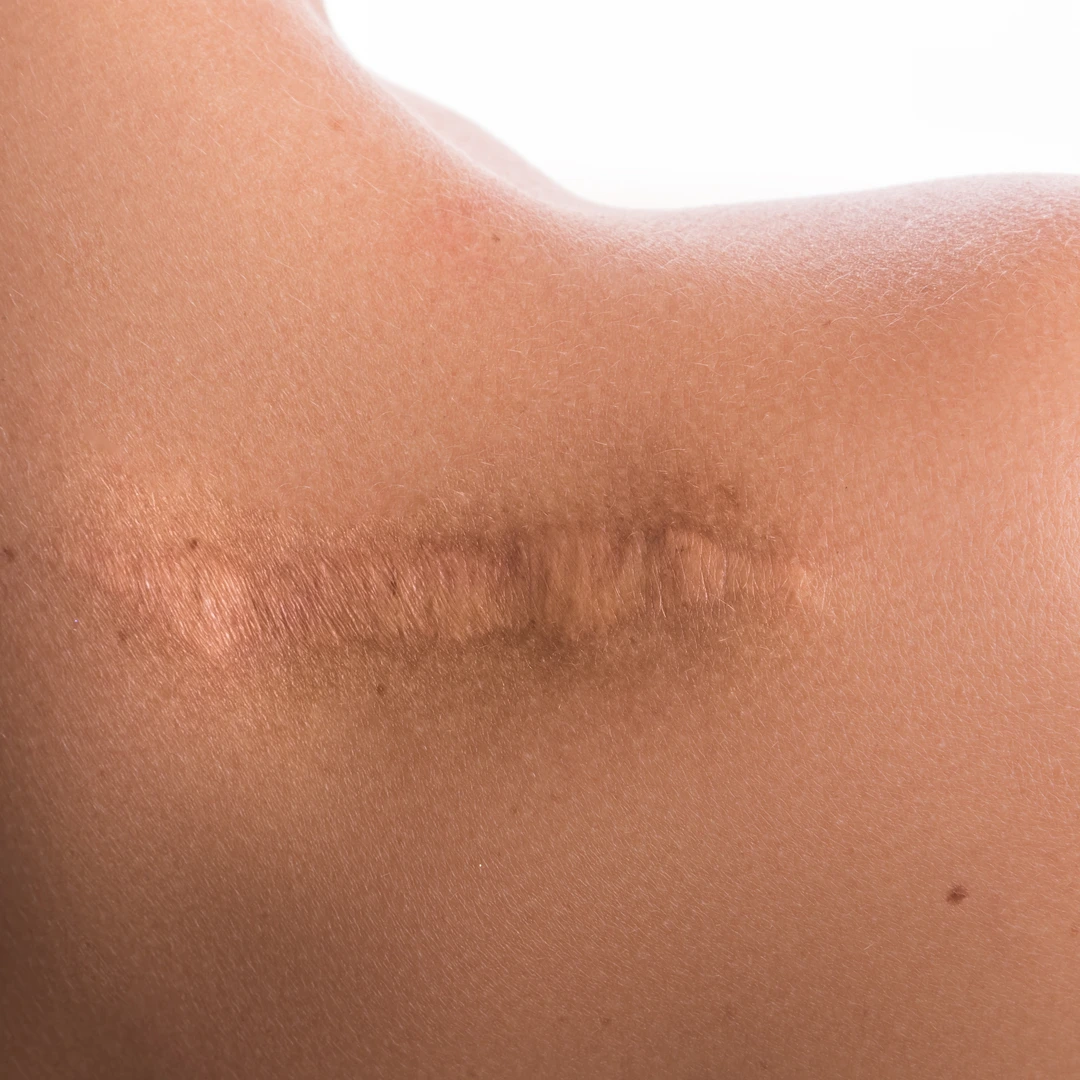
Depressed or atrophic scars are scars that sit lower than the surrounding skin. They often develop after acne, chickenpox, trauma, surgery, infection, burns, or inflammation. These scars form when the skin does not produce enough collagen during healing, or when fibrous bands pull the skin downwards, creating shadows, dents, and uneven texture.
At Skin & Scar Care Clinic, we offer a comprehensive, medically led approach to depressed and atrophic scar improvement. Rather than relying on one single treatment, we assess the scar type, depth, colour, texture, tethering, pigmentation, vascularity, skin type, and previous treatments before creating a bespoke treatment plan.
A combination approach is often required, as different scar features need different technologies. Subcision can release tethered scars, CO₂ laser can resurface texture, Erbium Glass laser can stimulate collagen with lower downtime, DPL can reduce redness, Pico laser can improve pigmentation, and regenerative treatments such as Bio Remodelling / Bio Stimulator®, PRF, and laser-assisted drug delivery can support skin remodelling. Laser resurfacing and subcision are established treatment options for atrophic scars, and combination treatment is commonly used where multiple scar characteristics are present.
What Are Depressed / Atrophic Scars?
Atrophic scars are caused by loss of collagen, loss of volume or tethering of the skin to deeper structures.
Common types include:
Ice-pick scars
Narrow, deep scars that look like small puncture marks. These are often more resistant and may require targeted resurfacing or focal treatment.
Boxcar scars
Wider, sharply defined depressions with steep edges. These often respond well to resurfacing, collagen stimulation, and sometimes subcision.
Rolling scars
Broad, wavy depressions caused by fibrous bands pulling the skin down. These usually benefit from subcision, regenerative treatments, and collagen-stimulating lasers.
Post-surgical or traumatic depressed scars
Scars that are indented following surgery, injury, infection, or previous procedures. Treatment depends on depth, tethering, colour, and skin quality.
Treatments Offered
1. CO₂ Laser Resurfacing
CO₂ laser is one of the gold-standard treatments for significant textural scarring, deeper atrophic scars, and uneven skin surface. It works by creating controlled micro-injuries in the skin, removing damaged surface layers and stimulating new collagen formation.
It can help improve:
- Depressed acne scars
- Textural irregularity
- Surgical or traumatic scar edges
- Uneven skin surface
- Fine lines around scarred skin
- Thickened or irregular scar borders
CO₂ laser is particularly useful where the scar has a rough, uneven, or sharply defined surface. It may be used alone or combined with subcision, PRF, Bio Remodelling / Bio Stimulator®, steroid delivery, or laser-assisted drug delivery.
Downtime: Usually 5–10 days depending on intensity.
Best for: More established scars, deeper texture, significant surface irregularity.
Limitations: Higher risk of pigmentation changes in darker skin types if not carefully selected and prepared. Laser resurfacing can improve acne scarring, but it requires an experienced laser practitioner and careful patient selection.
2. Subcision
Subcision is a minor surgical procedure used to release scars that are tethered down by fibrous bands. A fine needle or cannula is passed under the skin to break the tight bands pulling the scar down. Once released, the skin can lift and the body begins a new healing and collagen-remodelling process.
Subcision is particularly effective for:
- Rolling acne scars
- Tethered scars
- Depressed surgical scars
- Traumatic scars
- Scars that worsen in certain lighting
- Scars that feel stuck or fixed when the skin is stretched
Subcision is often combined with PRF, Bio Remodelling / Bio Stimulator®, polynucleotides, skin boosters, CO₂ laser, or Erbium Glass laser to enhance collagen regeneration and reduce recurrence of tethering. DermNet describes subcision as a technique used to divide fibrous strands beneath depressed scars, allowing the skin to return closer to its normal position.
Downtime: Bruising and swelling are common for 5–14 days.
Best for: Rolling, tethered, anchored scars.
Limitations: Not ideal for very superficial pigmentation-only marks or active acne.
3. Bio Remodelling / Bio Stimulator® / PRF Regenerative Treatment
Bio Remodelling / Bio Stimulator® and PRF are regenerative treatments used to improve skin quality, hydration, elasticity, and collagen remodelling.
Bio Remodelling / Bio Stimulator® is a highly purified hyaluronic acid injectable that helps improve hydration, firmness, and skin quality. In scar treatment, it may be used as part of a combination approach to support dermal remodelling and improve overall texture.
PRF — Platelet-Rich Fibrin uses the patient’s own blood-derived growth factors to support tissue repair, collagen production, and healing. PRF may be injected under scars after subcision or applied after laser resurfacing to support recovery.
These treatments can help with:
- Thin, crepey scarred skin
- Mild atrophic scars
- Post-laser recovery
- Skin quality improvement
- Collagen support after subcision
- Overall texture and elasticity
Best for: Mild to moderate atrophic scarring, skin quality improvement, combination protocols.
Limitations: Not usually enough as a standalone treatment for deep tethered scars.
4. Laser-Assisted Drug Delivery
Laser-assisted drug delivery uses fractional laser channels to enhance the penetration of selected topical medications or regenerative agents into the skin. After creating controlled micro-channels with a laser, carefully selected substances can be delivered into the treated area to support scar remodelling.
Depending on the scar type, this may involve:
- Anti-inflammatory medication
- Scar-modulating agents
- Regenerative serums
- PRF
- Skin boosters
- Depigmenting agents
- Collagen-supporting preparations
This treatment is especially useful where scars are complex and have more than one feature, such as indentation, inflammation, pigmentation, or firmness.
Best for: Complex scars, resistant scars, scars needing enhanced remodelling.
Limitations: Product choice depends on clinical assessment and suitability.
5. Erbium Glass Laser 1550nm
Erbium Glass laser is a non-ablative fractional laser that stimulates collagen without removing the top layer of skin. It is useful for patients who want skin remodelling with less downtime than CO₂ laser.
It can help improve:
- Mild to moderate atrophic scars
- Fine lines
- Skin texture
- Enlarged pores
- Early acne scarring
- Overall skin quality
- Collagen stimulation
Because it is non-ablative, Erbium Glass laser is often suitable for patients who prefer gradual improvement with lower downtime. It may be used before or after CO₂ laser, or as part of a maintenance plan.
Downtime: Usually mild redness and swelling for 24–72 hours.
Best for: Mild to moderate scars, early scars, texture, pores, collagen stimulation.
Limitations: Deep tethered scars usually need subcision or stronger resurfacing.
6. DPL Laser for Redness and Vascularity
Dynamic Pulse Light – DPL – is used to target redness, flushing, vascularity, and post-inflammatory erythema associated with scars.
It can help improve:
- Red scars
- Vascular scars
- Post-acne redness
- Post-inflammatory erythema
- Rosacea-associated redness around scars
- Persistent flushing
DPL does not lift depressed scars directly. Instead, it improves the colour component of the scar. This can be very important because red or inflamed scars can look more visible even when the texture has improved.
Best for: Redness, flushing, vascular scars.
Limitations: Does not treat scar depth or tethering.
7. Pico Laser for Pigmentation
Pico laser targets excess pigment using ultra-short pulses of energy. It can be helpful when atrophic scars are associated with pigmentation, brown marks, post-inflammatory hyperpigmentation, or uneven tone.
It can help improve:
- Brown acne marks
- Post-inflammatory hyperpigmentation
- Pigmented scars
- Uneven skin tone
- Mixed red/brown scar discolouration
- Pigmentation after previous inflammation
Pico laser is often used alongside resurfacing or collagen-stimulating treatments because pigmentation and texture require different treatment approaches.
Best for: Pigmentation, brown marks, uneven tone.
Limitations: Does not release tethered scars or significantly lift deep depressions.
Ideal For:
Depressed / atrophic scar treatment may be suitable for patients with:
- Acne scarring
- Chickenpox scars
- Surgical scars
- Traumatic scars
- Post-infection scars
- Rolling scars
- Boxcar scars
- Ice-pick scars
- Tethered scars
- Uneven skin texture
- Red or pigmented scars
- Scars causing shadowing in certain lighting
- Scars that have not improved with skincare alone
Who May Not Be Suitable
Treatment may not be suitable, or may need to be delayed, if you have:
- Active acne in the treatment area
- Active skin infection
- Cold sore outbreak or high risk without antiviral cover
- Recent isotretinoin use
- Pregnancy or breastfeeding, depending on treatment type
- Poorly controlled diabetes
- A history of poor wound healing
- Keloid tendency
- Recent tanning or sunburn
- Unrealistic expectations
- Open wounds or active dermatitis
- Recent facial surgery in the same area
- Certain autoimmune or photosensitive conditions
- Use of medications that increase photosensitivity or bleeding risk
Laser resurfacing is usually delayed after isotretinoin, and patients with darker skin types require careful planning because some lasers carry higher risk of post-inflammatory pigmentation. (Bad)
Limitations of Treatment
Depressed scars can usually be improved, but they cannot always be completely removed. The aim is to soften, lift, blend, and improve the scar so that it becomes less visible in normal lighting.
Important limitations include:
- Multiple sessions are usually required.
- Deep scars may need combination treatment.
- Ice-pick scars can be more resistant.
- Pigmentation may recur.
- Redness can take time to settle.
- Some scars may improve only partially.
- Collagen remodelling takes months.
- Maintenance may be needed.
Results vary depending on age, skin type, scar depth, scar age, genetics, and aftercare compliance.
Combinations Treatment
Most depressed scars respond best to a personalised combination plan. This is because a scar may have several components: depth, tethering, redness, pigmentation, rough texture, volume loss, and poor skin quality.
Common combinations include:
Subcision + PRF / Bio Remodelling / Bio Stimulator®
Ideal for rolling and tethered scars. Subcision releases the scar, while PRF or Bio Remodelling / Bio Stimulator® supports collagen and tissue remodelling.
CO₂ Laser + Laser-Assisted Drug Delivery
Ideal for textural scars, resurfacing, and complex scar remodelling.
Erbium Glass Laser + Pico Laser
Ideal for patients with mild atrophic scars plus pigmentation and uneven tone.
DPL + Pico Laser
Ideal when scars have both redness and pigmentation.
Subcision + CO₂ Laser
Ideal for deeper scars where tethering and surface texture both need correction.
CO₂ Laser + PRF
Useful for resurfacing and enhanced recovery support.
Erbium Glass Laser Maintenance After CO₂
Useful for long-term collagen stimulation and smoother skin quality.
Your Treatment Journey
1. Consultation and Scar Mapping
Your journey begins with a detailed consultation. We assess:
- Scar type
- Scar depth
- Skin type
- Pigmentation risk
- Redness and vascularity
- Tethering
- Previous treatments
- Medical history
- Downtime preference
- Budget and treatment goals
2. Personalised Treatment Plan
A bespoke plan is created depending on your scar type. Some patients need one main treatment; others need a staged plan over several months.
3. Skin Preparation
Before laser treatment, we may recommend:
- Daily SPF 50
- Pigmentation-suppressing skincare if needed
- Avoidance of tanning
- Stopping active ingredients before treatment
- Antiviral medication if prone to cold sores
- Optimising acne control before starting scar treatment
4. Treatment Sessions
Treatments may be performed every 4–8 weeks depending on the modality. Stronger treatments such as CO₂ laser may require longer intervals.
5. Healing and Remodelling
Initial healing may take days to weeks, but collagen remodelling continues for several months. Results usually build gradually.
6. Review and Maintenance
We review progress and adapt the plan depending on response. Maintenance sessions may be recommended for long-term skin quality and scar stability.
Results You Can Expect
Results vary from person to person, but patients may notice:
- Softer scar edges
- Improved skin texture
- Reduced shadowing
- Improved scar depth
- Brighter, more even skin tone
- Reduced redness
- Reduced pigmentation
- Improved collagen and firmness
- Smoother skin surface
- Better makeup application
- Improved confidence
Most patients require a course of treatments. Mild scars may improve with fewer sessions, while deep or complex scars often need several treatments over 3–12 months.
The goal is visible improvement, not perfection. Established scars can be difficult to treat, and results depend on scar type, skin type, healing response, and treatment compliance.
Key Benefits
- Bespoke treatment planning
- Medical-grade scar assessment
- Combination approach for complex scars
- Treatment options for depth, colour, texture, and tethering
- Suitable for acne, surgical, traumatic, and post-inflammatory scars
- Options for different downtime levels
- Collagen-stimulating technologies
- Skin quality improvement
- Can be tailored for different skin types
- Progressive, natural-looking improvement
Aftercare Advice
Aftercare depends on the treatment performed, but general advice includes:
- Keep the treated area clean and protected.
- Avoid touching, picking, or scratching the skin.
- Use SPF 50 daily.
- Avoid direct sun exposure.
- Avoid tanning beds.
- Avoid strong active skincare until advised.
- Avoid retinoids, acids, exfoliants, and vitamin C for the recommended period.
- Avoid swimming, sauna, steam rooms, and heavy exercise for 24–72 hours or longer after stronger treatments.
- Use recommended healing ointment or moisturiser.
- Avoid makeup for the advised period after laser treatment.
- Sleep slightly elevated if swelling occurs.
- Contact the clinic if you develop increasing pain, blistering, pus, spreading redness, or unusual swelling.
For CO₂ laser, aftercare is more intensive and may involve several days of wound care, gentle cleansing, barrier repair, and strict sun avoidance.
Treatment Summary
| Treatment | Best For | Downtime | Typical Course |
| CO₂ Laser | Deep texture, resurfacing, scar edges | 5-10 days | 1-3 sessions |
| Subcision | Rolling, tethered, depressed scars | 5-14 days bruising/swelling | 1-3 sessions |
| Bio Remodelling / Bio Stimulator® / PRF | Skin quality, collagen support, healing | Minimal to mild | 2-3 sessions |
| Laser-Assisted Drug Delivery | Complex scars, enhanced remodelling | Varies | Bespoke |
| Erbium Glass 1550nm | Mild/moderate scars, texture, pores | 1-3 days | 3-6 sessions |
| DPL Laser | Redness, flushing, vascularity | Minimal | 3-6 sessions |
| Pico Laser | Pigmentation and brown marks | Minimal | 3-6 sessions |
Frequently Asked Questions
Disclaimer
Skin & Scar Care Clinic is a medical-grade clinic providing advanced scar treatments with a focus on safety, clinical judgement, and patient satisfaction.
We guarantee our expertise, professional standards, and best efforts; however, specific results cannot be guaranteed. Outcomes vary depending on scar type, scar depth, skin type, age, ethnicity, healing response, medical history, lifestyle factors, and compliance with aftercare.
Depressed and atrophic scar treatment usually requires a staged and combination approach. Multiple sessions may be required, and maintenance may be advised. Pigmentation, redness, and active acne may relapse, and the natural ageing process will continue.
A face-to-face consultation is required before treatment to assess suitability, risks, expected outcomes, and the most appropriate personalised treatment plan.
Following a recent consultation with Mr Salahuddin to discuss various aesthetic treatments, including ebrium laser, c02 laser and endolift. I had my first session of ebrium laser treatment today. I can honestly say Mr Salahuddin's approach is excellent! He was very informative and went into great detail about each treatment, whilst remaining courteous, honest and professional at all times. We worked out a plan 'together' and he helped with any concerns I had. I am excited to start my journey with him and I have more than 100% faith in his ability as a medical professional to give me the results I want to achieve. I would highly recommend Mr Salahuddin, his expertise is second to none.
Joan Loudon