
Non-surgical treatment for mild to moderate hooding, crepey eyelids and tired-looking eyes
At Skin and Scar Care Clinic, we offer medical-led treatments for hooded eyelids, eyelid wrinkles, crepey eyelid skin, brow heaviness and tired-looking eyes.
Hooded eyelids can make the eyes look smaller, heavier or more tired. In mild to moderate cases, non-surgical treatment may help improve skin quality, tighten the eyelid area, support the brow and soften wrinkles.
Our treatment options may include:
- Endolift® for mild to moderate eyelid hooding and brow support
- CO₂ laser for eyelid wrinkles and crepey skin
- Anti-wrinkle injections for brow lifting and wrinkle softening
- Viscoderm Hydrobooster for eyelid hydration and fine lines
- Temple bioremodelling for lateral brow support
- Combination treatment where suitable
- Surgical referral where non-surgical treatment is not appropriate
Our focus is on natural-looking improvement, realistic expectations and patient safety.
What are hooded eyelids?
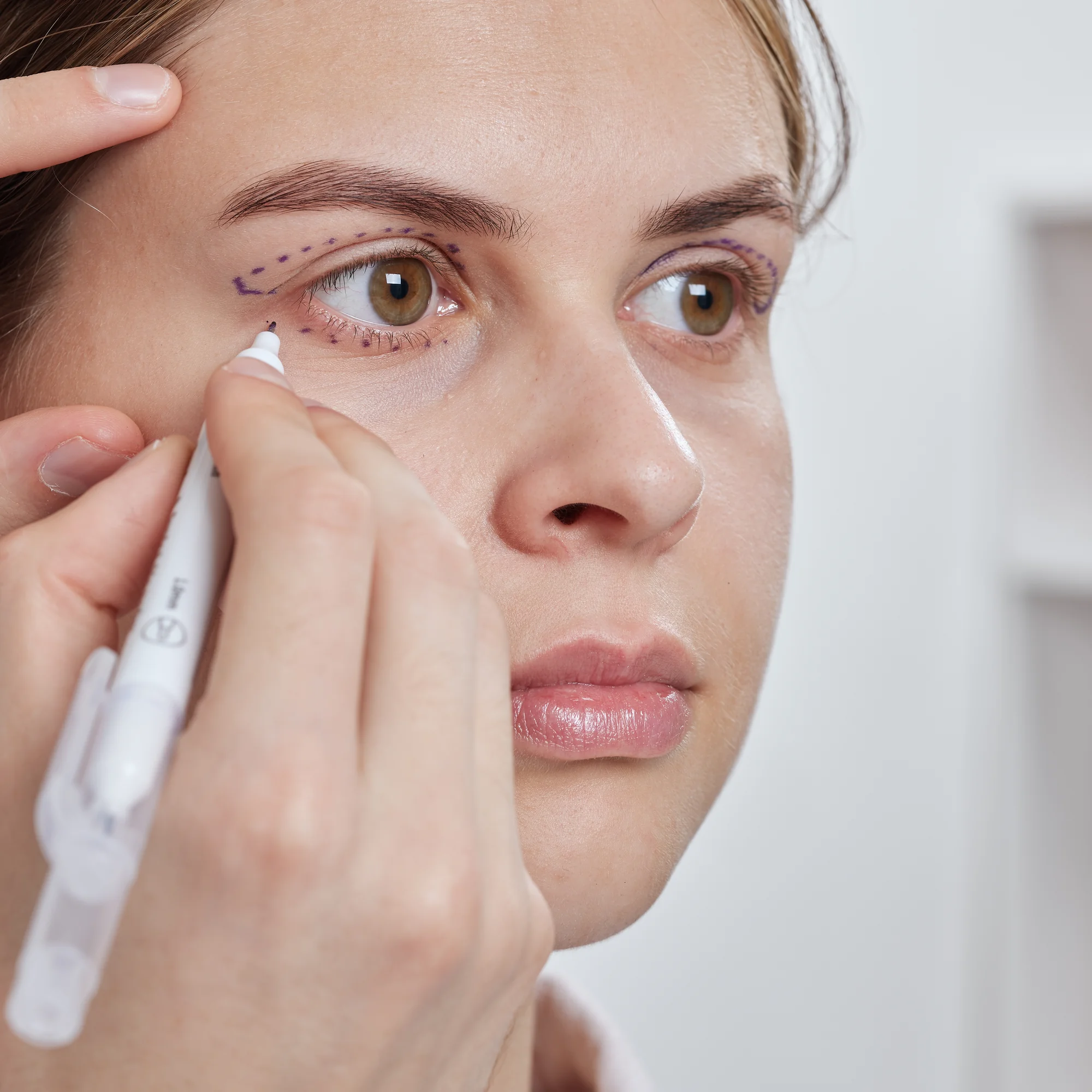 Hooded eyelids occur when skin or tissue sits over the upper eyelid crease, making the upper eyelid look heavier or less visible.
This may affect one or both eyes and can be mild, moderate or severe.
Clients often describe hooded eyelids as:
- Heavy upper eyelids
- Loose eyelid skin
- Tired-looking eyes
- Reduced eyelid crease
- Difficulty applying eye make-up
- Eyelid skin resting on the lashes
- Outer eyelid heaviness
- Wrinkled or crepey upper eyelid skin
- Brow heaviness pushing skin downwards
For this page, our main focus is mild to moderate hooding, where non-surgical treatments may be suitable.
What causes hooded eyelids and eyelid wrinkles?
Hooded eyelids and eyelid wrinkles can happen for several reasons.
1. Ageing and collagen loss
As we age, collagen and elastin reduce. The delicate eyelid skin becomes thinner, looser and more wrinkled.
2. Sun damage and photoageing
The eyelid skin is very thin and can show early signs of sun damage. This may cause fine lines, crepiness, laxity and rougher texture.
3. Brow droop
Sometimes the eyelid itself is not the main problem. A low or heavy brow can push skin downwards, creating the appearance of hooded eyelids.
4. Temple hollowing and loss of support
The temple area supports the outer brow. With ageing, weight loss or natural anatomy, temple hollowing can make the lateral brow appear lower and contribute to outer eyelid hooding.
5. Genetics
Some people naturally have hooded eyelids or heavier upper eyelids from a younger age.
6. Weight loss
Significant weight loss can reduce facial support and make loose eyelid skin or brow heaviness more visible.
7. Muscle activity
Repeated facial expression, frowning, squinting and forehead movement can contribute to lines around the eyelids and forehead.
8. True eyelid ptosis
In some cases, the eyelid itself sits lower because the eyelid-lifting muscle is weak or stretched. This is called ptosis and may need ophthalmology or oculoplastic assessment rather than cosmetic treatment.
Hooded eyelids, brow droop or ptosis — what is the difference?
Many clients describe any upper-eye heaviness as “hooded eyelids”, but the cause can be different.
Hooded eyelid skin
There is excess or loose skin over the upper eyelid crease. This may respond to skin tightening treatments in mild to moderate cases.
Brow droop
The eyebrow sits lower than ideal and pushes skin down towards the eyelid. Brow support treatments may be more helpful than eyelid treatment alone.
Eyelid ptosis
The eyelid margin itself sits too low over the eye because the eyelid-lifting muscle is weak. This may affect vision and may require medical or surgical assessment.
During your consultation, we assess the eyebrow position, eyelid skin, eyelid margin, forehead movement, temple hollowing and facial symmetry to identify the true cause.
Treatment options for mild to moderate hooded eyelids
Endolift® for mild to moderate hooded eyelids
Endolift® is a minimally invasive laser treatment that works beneath the skin to stimulate collagen remodelling, skin tightening and gentle tissue contraction.
For suitable clients, Endolift® may help improve:
- Mild to moderate upper eyelid hooding
- Lateral brow heaviness
- Loose skin around the upper eyelid
- Crepey eyelid skin
- Tired-looking eyes
- Mild asymmetry
- Brow support
- Skin tightening around the upper eye area
Endolift® is particularly useful when eyelid hooding is linked to mild skin laxity, brow heaviness or tissue looseness.
What to expect with Endolift®
Endolift® is usually performed under local anaesthetic. A very fine laser fibre is used beneath the skin to deliver controlled laser energy.
You may experience swelling, bruising, tenderness or tightness afterwards.
Results are gradual and usually continue to improve over 3–6 months as collagen remodelling develops.
What Endolift® cannot do
Endolift® is not a replacement for upper blepharoplasty surgery. It cannot remove large amounts of excess eyelid skin and cannot guarantee perfect symmetry.
If the hooding is severe or affecting vision, surgical assessment may be more appropriate.
CO₂ laser for eyelid wrinkles and crepey skin
CO₂ laser is a resurfacing and tightening treatment used to improve wrinkled, crepey and sun-damaged eyelid skin.
It is particularly helpful when the main concern is skin quality rather than heavy tissue excess.
CO₂ laser may help improve:
- Fine lines around the eyes
- Crepey upper eyelid skin
- Wrinkled lower eyelid skin
- Sun-damaged eyelid skin
- Mild eyelid skin laxity
- Texture around the eyes
- Tired-looking eyes
- Skin tightening around the eyelid area
What to expect with CO₂ laser
CO₂ laser involves downtime. The treated skin may become red, swollen, dry, crusted, sensitive or darker before it heals.
Strict aftercare and sun protection are essential.
Early improvement may be seen within a few weeks, but collagen remodelling continues over several months.
CO₂ laser and hooded eyelids
CO₂ laser can improve the skin envelope, texture and fine wrinkles. It may provide mild tightening in selected cases, but it does not replace surgical eyelid skin removal where there is significant excess skin.
Anti-wrinkle injections for brow lift and wrinkle softening
Anti-wrinkle injections can be used to relax selected muscles that pull the brow down. This may allow the brow-lifting muscles to create a subtle lift.
This can be helpful when hooded eyelids are partly caused by brow heaviness or muscle imbalance.
Anti-wrinkle injections may help improve:
- Mild brow heaviness
- Heavy outer brows
- Forehead wrinkles
- Frown lines
- Crow’s feet
- Brow shape
- Mild hooding caused by brow position
- Tired or angry-looking expression
Important note about anti-wrinkle injections
Anti-wrinkle injections must be planned carefully around the forehead and eyes. If the forehead lifting muscle is over-relaxed, the brows can feel heavier.
Possible side effects include temporary heaviness, asymmetry, headache, bruising, eyelid droop, brow droop or incomplete correction.
For this reason, treatment is usually conservative and reviewed carefully.
Viscoderm Hydrobooster for eyelid wrinkles and hydration
Viscoderm Hydrobooster is an injectable skin-quality treatment designed to improve hydration, elasticity and fine lines in delicate areas.
It is not a filler and is not designed to make the eyelids heavy or puffy. Instead, it supports skin quality and hydration.
Viscoderm Hydrobooster may help improve:
- Fine lines around the eyes
- Crepey eyelid skin
- Thin or dehydrated eyelid skin
- Mild lower eyelid wrinkles
- Skin elasticity
- Early ageing around the eyes
- Texture around the periocular area
A course of 2 sessions, usually spaced around 4 weeks apart, may be recommended.
What to expect with Viscoderm Hydrobooster
Small injections are placed carefully around the eye area. Mild swelling, bruising, tenderness or small bumps may occur temporarily.
This treatment is best for skin quality and fine lines. It does not remove excess skin or replace laser or surgery.
Temple bioremodelling for lateral brow and eyelid support
The temple area plays an important role in supporting the outer brow and upper face.
When the temples become hollow, the outer brow can lose support, making hooding around the outer eyelid more noticeable.
Temple bioremodelling uses injectable regenerative treatments to improve tissue quality and support around the temple area.
At Skin and Scar Care Clinic, this may include Bio Remodelling / Bio Stimulator Structura, Bio Remodelling / Bio Stimulator or other suitable biostimulatory approaches, depending on consultation and suitability.
Temple bioremodelling may help improve:
- Temple hollowing
- Lateral brow support
- Outer eyelid hooding
- Upper-face tiredness
- Skin quality
- Mild facial skeletonisation after weight loss
- Transition between temple, forehead and cheek
What to expect with temple bioremodelling
Treatment is usually performed using carefully placed injectable product. The aim is not to overfill the temples, but to restore support and improve tissue quality gradually.
A course of 2 sessions, usually around 4 weeks apart, may be recommended depending on the treatment plan.
Mild swelling, bruising, tenderness or temporary lumps can occur.
Combination treatment for mild to moderate hooded eyelids
Hooded eyelids often have more than one cause, so combination treatment may give the most natural improvement.
If the main issue is loose or crepey eyelid skin
Recommended treatments may include:
- CO₂ laser
- Viscoderm Hydrobooster
- Endolift® in selected cases
If the main issue is brow heaviness
Recommended treatments may include:
- Anti-wrinkle injections
- Endolift® brow support
- Temple bioremodelling if there is temple hollowing
If the main issue is mild to moderate hooding after weight loss
Recommended treatments may include:
- Endolift®
- CO₂ laser
- Hydrobooster
- Temple bioremodelling
If the main issue is severe excess skin
Non-surgical treatment may not be enough. Surgical upper blepharoplasty or brow-lift assessment may be advised.
Treatment timeline
Consultation
We assess the brow, eyelid skin, eyelid margin, temple support, forehead movement, symmetry and medical history. We will confirm whether your concern is mild to moderate hooding, brow droop, eyelid wrinkles, eyelid ptosis or a combination.
Anti-wrinkle injections
- Starts working: usually 3–7 days
- Best result: around 2 weeks
- Duration: commonly 3–4 months
- Review: around 2 weeks if needed
Viscoderm Hydrobooster
- Mild swelling or bumps: usually temporary
- Early hydration: 1–2 weeks
- Suggested course: 2 sessions, around 4 weeks apart
- Best result: usually after the treatment course
Endolift®
- Early swelling/tightness: first few days to weeks
- Early improvement: 4–8 weeks
- Collagen remodelling: 3–6 months
- Final result: usually assessed at 3–6 months
CO₂ laser
- Initial downtime: several days depending on intensity
- Redness and sensitivity: can last longer depending on settings and skin type
- Early improvement: 2–6 weeks
- Collagen improvement: 3–6 months
Temple bioremodelling
- Mild swelling or tenderness: a few days
- Early support: within weeks
- Best result: often after 2 sessions
- Maintenance: individualised
Suitable candidates
You may be suitable for non-surgical hooded eyelid or eyelid wrinkle treatment if you have:
- Mild to moderate hooded eyelids
- Mild upper eyelid skin laxity
- Crepey eyelid skin
- Eyelid wrinkles or fine lines
- Heavy outer brows
- Brow-related eyelid hooding
- Temple hollowing with outer brow heaviness
- Tired-looking eyes
- Good general health
- Realistic expectations
- Preference for non-surgical treatment
- No untreated medical cause of eyelid droop
Who may not be suitable?
You may not be suitable for non-surgical treatment if you have:
- Severe hooded eyelids requiring surgery
- Upper eyelid skin resting heavily on the lashes
- Hooding affecting your vision
- True eyelid ptosis
- Sudden eyelid droop
- New one-sided eyelid or eyebrow droop
- Vision changes or double vision
- Eye pain or severe headache
- Active eye infection
- Active skin infection in the treatment area
- Recent eyelid surgery that has not healed
- Uncontrolled medical conditions
- Pregnancy or breastfeeding
- Known allergy to proposed products
- High bruising or bleeding risk without assessment
- History of poor wound healing or keloid scarring
- Unrealistic expectations
- Need for a surgical-level result
If we believe you would benefit more from surgical upper blepharoplasty, brow lift or ophthalmology assessment, we will advise you honestly.
When to seek medical advice first
Please seek medical advice before cosmetic treatment if eyelid hooding or drooping is:
- Sudden
- One-sided and new
- Affecting your vision
- Associated with double vision
- Associated with eye pain
- Associated with severe headache
- Associated with facial weakness
- Associated with slurred speech
- Associated with unequal pupils
- Associated with numbness or weakness elsewhere in the body
Aesthetic treatment should never delay urgent medical assessment.
Aftercare advice
After treatment, you will receive personalised aftercare depending on the treatment performed.
General advice may include:
- Avoid rubbing or massaging the treated area unless advised
- Avoid make-up for the rest of the day after injectable treatments where possible
- Avoid strenuous exercise for 24–48 hours
- Avoid alcohol for 24 hours after injectable treatment
- Avoid sauna, steam rooms and excessive heat
- Avoid lying flat for several hours after anti-wrinkle injections
- Use SPF 50 after laser treatment
- Avoid active skincare until advised after CO₂ laser
- Keep the area clean after laser treatment
- Sleep slightly elevated if swelling is present
- Contact the clinic if you develop severe pain, worsening swelling, infection symptoms, skin colour change, visual symptoms or significant asymmetry
Frequently Asked Questions
Can hooded eyelids be treated without surgery?
Yes, mild to moderate hooded eyelids may improve with non-surgical treatments such as Endolift®, CO₂ laser, anti-wrinkle injections, Viscoderm Hydrobooster or temple bioremodelling. Severe hooding may still require surgery.
What is the best treatment for mild hooded eyelids?
Can Endolift® help hooded eyelids?
Can CO₂ laser tighten eyelid skin?
Can anti-wrinkle injections lift hooded eyes?
Is Hydrobooster a filler?
Can temple treatment improve hooded eyelids?
When is surgery better?
Why choose Skin and Scar Care Clinic?
At Skin and Scar Care Clinic, we provide medical-grade aesthetic treatments with a careful, personalised and safety-led approach.
We focus on:
- Careful eyelid and brow assessment
- Identifying the true cause of hooding
- Natural-looking results
- Non-surgical treatment for mild to moderate hooded eyelids
- Endolift®, CO₂ laser, anti-wrinkle injections, Hydrobooster and temple bioremodelling
- Honest advice about surgical versus non-surgical options
- Realistic expectations
- Aftercare support
We will always advise you if non-surgical treatment is not the safest or most effective option.
Book a Hooded Eyelids Consultation in Altrincham
If you are concerned about hooded eyelids, eyelid wrinkles, crepey eyelid skin, heavy brows or tired-looking eyes, book a consultation at Skin and Scar Care Clinic.
We will assess whether your concern is due to mild to moderate eyelid hooding, brow droop, eyelid skin laxity, temple hollowing, ptosis or a combination.
Skin and Scar Care Clinic
25 Barrington Road
Altrincham
WA14 1HP
WhatsApp / Tel: 07376 311884
Website: www.skinscarcare.com
Disclaimer
Hooded eyelid and eyelid wrinkle treatments are medical aesthetic treatments and results vary between individuals. Treatment outcomes cannot be guaranteed.
Hooded eyelids may be caused by ageing, genetics, skin laxity, brow droop, temple hollowing, muscle imbalance, weight loss, previous treatments, eyelid ptosis or medical causes. A consultation is required to assess the true cause.
Endolift®, CO₂ laser, anti-wrinkle injections, Viscoderm Hydrobooster and temple bioremodelling can improve selected cases of mild to moderate hooding, eyelid wrinkles, crepey eyelid skin and brow-related heaviness. However, they are not alternatives to upper blepharoplasty, brow lift or oculoplastic surgery where significant excess skin, true ptosis or visual field obstruction is present.
Possible side effects include redness, swelling, bruising, tenderness, asymmetry, temporary brow heaviness, eyelid droop, headache, dry skin, crusting, pigmentation change, infection, delayed healing, scarring, incomplete improvement and the possible need for further treatment.
Rare but serious complications can occur with any treatment around the eyes. Please seek urgent medical help if you experience sudden drooping, vision changes, double vision, severe headache, facial weakness, severe pain, increasing swelling, skin colour change or signs of infection.
We always aim to provide 100% effort, but final results depend on anatomy, skin quality, muscle activity, degree of laxity, age, medical history, healing response, lifestyle factors and adherence to aftercare.