
Following surgery from around my eyes which left me with a deep scars above both of my eyebrows, I was introduced to Omer at the Skin & Scar Care Clinic. My first impression was that he was very professional, experienced, knowledgeable and friendly. As a result of this and that I was very impressed with the work he had previously done, I decided he was the right person to help deal with these unsightly scars. Omer is very approachable and always ready to help wherever possible. Following several treatments I could see an improvement each time. Although I know I have to be patient, Omer is trying his very best by using different methods to help reduce these scars. Nothing is an issue for him as he will accommodate regardless of what needs to be done. The equipment he has, is very impressive and likely he could carry out any procedure required. Due to this and at 62 years, I am now undertaking further treatment to help reduce aging from around my eyes, including puffiness, wrinkles and marks on the skin. It's too early to say at the moment, but I have a lot of confidence in Omer and I'm very confident he will do his very best and that I will have an improved outcome. I can only but recommend this business, as I'm sure whatever treatment you need, you will be very happy with the results.
Amk AmkI came to Skin & Scar to remove a small cyst. Dr Omer talked me through what to expect with the procedure & how to care following, putting my mind at ease. So I decided to also do something about the many moles (side effect from living in warmer climate as a child), skin tags and various older scars due to numerous past surgeries. I’m so glad I did! I’d been self conscious for too long. Dr Omer uses state of the art laser technology, of which he is has plenty and is an expert in using. I couldn’t recommend him highly enough.
Sally WhartonScars are the body’s natural response to healing after injury, surgery, acne, burns, inflammation, or trauma. In many cases, scars settle well over time. However, some scars can become raised, thickened, tethered, discoloured, uneven, uncomfortable, or cosmetically noticeable.
At Skin & Scar Care Clinic, we specialise in advanced scar improvement using a personalised, multimodality approach. Our treatments combine medical-grade lasers, injectable therapies, collagen-stimulating treatments, subcision, skin resurfacing, and TED — Transepidermal Drug Delivery — to help make scars softer, flatter, more pliable, and less visible.
Scar improvement is a gradual process. Most patients require a course of treatments, carefully tailored to the type of scar, skin tone, scar depth, healing response, and desired outcome.
For darker skin types, treatment is approached with additional caution to reduce the risk of post-inflammatory hyperpigmentation, also known as PIH, where the skin may become darker after inflammation or laser treatment. In these cases, more sessions may be required, often using gentler settings and appropriate skin preparation.
Whether you are concerned about surgical scars, acne scars, trauma marks, stretch marks, chickenpox scars, burn scars, self-harm scars, hypertrophic scars, or keloids, we understand that scars can affect not only the skin but also your confidence. Our specialist-led Scar Management Clinic offers evidence-based treatments designed to visibly improve a wide range of scar types.
Understanding Scars
Scars form when the body produces collagen to repair damaged skin. The final appearance of a scar depends on several factors, including:
- The cause of the injury
- The depth of skin damage
- Skin type and ethnicity
- Genetics
- Infection or delayed healing
- Scar location
- Tension across the wound
- Previous treatments
- Age and general health
Not all scars behave in the same way. Some become raised and firm, some become indented, some appear red or dark, and others may become pale or white.
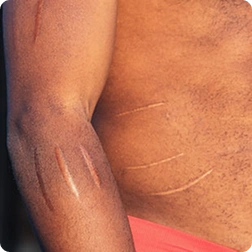
Types of Scars We Treat

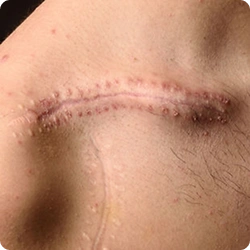
Surgical Scars
These may occur after procedures such as C-sections, facelifts, tummy tucks, breast surgery, mole removal, laparoscopic surgery, or other operations. Surgical scars may be flat, raised, widened, red, tethered, or uneven.
Traumatic Scars
These can result from accidents, cuts, lacerations, burns, or injuries. They may be irregular in shape and may involve texture change, pigmentation, or tightness.


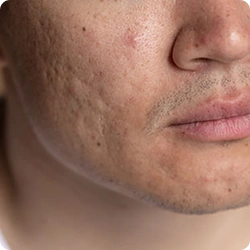
Acne Scars
Acne scars are commonly caused by inflammation damaging the deeper layers of the skin. These may include:
- Atrophic scars
- Rolling scars
- Boxcar scars
- Ice-pick scars
- Tethered scars
- Post-inflammatory pigmentation
- Red acne marks
Hypertrophic Scars
These are thickened, raised scars that remain within the boundaries of the original wound. They may feel firm, itchy, red, or uncomfortable.


Keloid Scars
Keloids are overgrown raised scars that extend beyond the original injury site. They can continue to grow over time and may require careful long-term management.
Self-Harm Scars
Self-harm scars can vary significantly in appearance and may present as linear, raised, depressed, pigmented, pale, or textured scars. These scars often carry emotional as well as physical significance and can affect confidence, self-esteem, and quality of life.
At Skin & Scar Care Clinic, we provide a compassionate, non-judgemental, and confidential approach to self-harm scar management. Treatment plans are tailored to the individual and may include fractional laser resurfacing, pigment correction, collagen-stimulating treatments, subcision, skin remodelling therapies, TED, and medical skincare. While self-harm scars cannot usually be completely removed, treatment can often help soften their appearance, improve texture and colour, and make them less noticeable.

Contracture Scars
These often occur after burns and may tighten the skin, sometimes restricting movement. They may require a combination of medical, laser, injectable, and sometimes surgical treatment.
Pigmented or Discoloured Scars
Scars may appear red, brown, dark, pale, or white. Pigmentation changes are especially common after acne, inflammation, trauma, or burns.


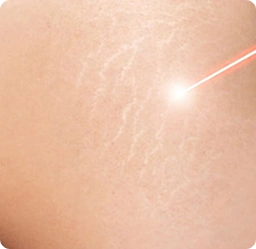
Stretch Marks
Stretch marks are a form of dermal scarring caused by stretching of the skin. They may appear red, purple, silver, or white and can benefit from collagen-stimulating treatments.
Treatment Options Tailored to You
Every scar is unique. Your treatment plan will be designed after a detailed consultation and may involve one or more treatment modalities.
1. Laser Scar Revision
Laser treatment is one of the core treatments for scar improvement. Depending on the scar type, we may use fractional, ablative, vascular, pigment-targeting, or collagen-stimulating laser technology.
Laser scar revision can help to:
- Smooth uneven scar texture
- Flatten raised scars
- Stimulate new collagen production
- Improve scar flexibility
- Reduce redness
- Improve pigmentation
- Improve skin tone and texture
- Reduce scar visibility over time
Lasers We Use
CO₂ Fractional Laser
CO₂ laser is often considered the gold standard for resurfacing acne scars, surgical scars, traumatic scars, self-harm scars, and textural irregularities. It helps remodel scar tissue and stimulate new collagen.
Vascular Laser / DPL Technology
Used to reduce redness, visible blood vessels, and vascular activity within red scars.
Pico Laser
Useful for hyperpigmented scars and post-inflammatory pigmentation. It can help break down excess pigment and improve skin tone.
Excimer 308nm Laser
Used in selected cases of pale or hypopigmented scars to support repigmentation.
Erbium Glass 1550nm Laser
A non-ablative fractional laser used to improve texture, fine lines, collagen quality with less downtime than more aggressive resurfacing.
Endolift / Endolaser
In selected tethered, fibrotic, or contour-related scars, Endolift may help improve deeper scar tissue, collagen remodelling, and skin tightening.
2. TED — Transepidermal Drug Delivery
TED, or Transepidermal Drug Delivery, may be used alongside laser treatments to enhance scar remodelling.
After creating controlled microchannels in the skin, selected medical agents may be delivered into the scar tissue to support softening, flattening, pigmentation improvement, or collagen remodelling.
Depending on the scar type and clinical suitability, these may include:
- Steroids
- Hyaluronic acid
- 5-FU
- Polynucleotides
- PLLA
- CaHA
- Other clinician-selected agents
The aim is to make scars softer, more flexible, flatter, and less visible.
3. Injectable Scar Treatments
Steroid Injections
Steroid injections can be effective for raised, thickened, hypertrophic, or keloid scars. They help reduce inflammation, flatten scar tissue, and improve symptoms such as itching or tenderness.
In some cases, steroid treatment may be combined with laser-assisted drug delivery for better scar penetration.
5-FU Injections
5-FU may be used in selected resistant hypertrophic or keloid scars, often in combination with steroid treatment. This is only performed where clinically appropriate.
PRF — Platelet-Rich Fibrin
PRF uses your own blood-derived growth factors to support healing and skin regeneration. It may be used in selected scars to improve tissue quality and recovery.
Skin Boosters and Mesotherapy
Skin boosters can improve hydration, elasticity, and overall skin quality around scarred areas.
4. Biostimulators for Depressed Scars and Stretch Marks
Biostimulators may be used for depressed scars, contour irregularities, volume loss, stretch marks, and selected self-harm scars where collagen stimulation may improve texture and blending.Common biostimulators include:
- PLLA, such as Sculptra
- CaHA, such as calcium hydroxylapatite-based treatments
These treatments work by stimulating collagen production gradually, helping to improve texture, contour, and skin firmness over time.
5. Subcision
Subcision is used for tethered scars, especially rolling acne scars. A specialised technique is used to release fibrous bands pulling the scar downwards.
Subcision may be combined with:
- Laser resurfacing
- PRF
- Polynucleotides
- Hyaluronic acid fillers
- Biostimulators
- Skin boosters
This combination can help lift depressed scars and improve overall skin smoothness.
6. Chemical Peels
Chemical peels may help improve superficial scars, pigmentation, acne marks, and uneven skin tone.
They are often used as part of a broader scar treatment programme rather than as a standalone treatment for deeper scars.
7. Topical Regimens
Prescription-strength skincare may be recommended before, during, or after treatment to optimise outcomes.
This may include:
- Pigment-suppressing creams
- Retinoids
- Silicone gels
- SPF
- Barrier-repair creams
- Hydrating products
- Anti-inflammatory skincare
Good skincare compliance can significantly improve treatment safety and results, especially in darker skin types.
8. Surgical Scar Revision
Surgical correction was once considered the main treatment for scar management. Today, it is usually reserved for more complex scars that are unlikely to improve sufficiently with non-surgical treatments alone.
Where appropriate, surgical scar revision may be combined with laser, steroid injections, silicone therapy, or other scar-management treatments to reduce the chance of recurrence.
Ideal Candidates for Scar Treatment
Scar treatment may be suitable for people who have:
- Acne scars
- Surgical scars
- C-section scars
- Facelift or cosmetic surgery scars
- Trauma scars
- Self-harm Scars
- Burn scars
- Chickenpox scars
- Stretch marks
- Raised scars
- Keloid scars
- Red scars
- Brown or pigmented scars
- Pale or white scars
- Tethered or indented scars
- Thickened or itchy scars
- Scars affecting confidence or self-esteem
Treatment is suitable for both men and women and can be performed on the face or body, depending on the scar type and location.
Who May Not Be Suitable?
Scar treatment may not be suitable, or may need to be delayed, if you:
- Are pregnant or breastfeeding
- Have active infection in the treatment area
- Have active cold sores, unless treated preventatively
- Have recently used isotretinoin, depending on the treatment type
- Have uncontrolled diabetes
- Have poor wound healing
- Have a history of severe keloid formation
- Have unrealistic expectations
- Are unable to follow aftercare instructions
- Have very recent sun exposure or active tanning
- Are taking certain medications that affect healing or light sensitivity
- Have an active inflammatory skin condition in the treatment area
A full consultation is required to assess suitability.
Limitations of Scar Treatment
Scar treatment can significantly improve the appearance, texture, colour, and flexibility of scars, but it cannot completely erase a scar.
Important limitations include:
- Scars cannot usually be removed completely
- Multiple sessions are usually required
- Some scars respond better than others
- Keloids can recur despite treatment
- Pigmentation may relapse
- Darker skin types require a more cautious approach
- Results vary from person to person
- Older or deeper scars may need more sessions
- Surgical scars under tension may be more difficult to improve
- Maintenance may be required for some scar types
Our goal is to make scars less visible, softer, flatter, smoother, and more acceptable in appearance.
Combination Treatment Options
The best scar results often come from combining treatments rather than relying on one method alone.
Common combinations include:
Acne Scars
- Subcision
- CO₂ laser
- Erbium glass laser
- PRF
- Biostimulators
- TCA CROSS for selected ice-pick scars
- Pico laser for pigmentation
Raised or Keloid Scars
- Steroid injections
- 5-FU
- Vascular laser
- Silicone gel
- CO₂ laser-assisted drug delivery
- Long-term monitoring
Surgical Scars
- CO₂ laser
- Vascular laser
- TED
- Steroid injections if raised
- Silicone gel
- Scar massage
- Pico laser for pigmentation
Burn Scars
- Fractional laser
- Vascular laser
- Steroid injections
- Scar softening treatments
- Physiotherapy referral if movement is restricted
Stretch Marks
- CO₂ laser
- Erbium glass laser
- Biostimulators
- PRF
- Polynucleotides
- Skin boosters
Pigmented Scars
- Pico laser
- Topical pigment suppression
- Medical skincare
- SPF
- Gentle fractional laser if appropriate
Your Scar Treatment Journey
1. In-Depth Consultation
Your journey begins with a detailed consultation. We assess:
- Scar type
- Scar depth
- Scar age
- Scar colour
- Skin type
- Previous treatments
- Medical history
- Risk of pigmentation
- Tethering or firmness
- Symptoms such as itching, pain, or tightness
- Your goals and expectations
2. Personalised Treatment Plan
Your treatment plan is tailored to your skin and scar type. Some patients need laser alone, while others benefit from a combination of lasers, injectables, subcision, TED, biostimulators, or topical skincare.
For darker skin tones, we may recommend skin priming before laser treatment to reduce the risk of pigmentation changes. Wanna play Minecraft Leo you can use no it's not you have to press the slowly down and then push it's not working circle just one minute where is it
3. Treatment Preparation
Depending on your treatment, preparation may include:
- SPF use
- Avoiding tanning
- Pigment-suppressing skincare
- Hydration and barrier repair
- Stopping certain active skincare temporarily
- Numbing cream before treatment
- Antiviral medication if prone to cold sores
- Baseline photographs
4. Laser or Combination Therapy
Treatment is performed with medical-grade precision. Depending on the scar and treatment type:
- Numbing cream may be applied
- Laser treatment may be performed
- Injectable scar treatment may be used
- TED may be added
- Subcision may be performed for tethered scars
- Skin boosters or biostimulators may be used where appropriate
5. Recovery and Results
After treatment, you may experience:
- Redness
- Swelling
- Mild tenderness
- Skin dryness
- Crusting or flaking after resurfacing
- Temporary darkening of pigmentation
- Mild bruising after injectable treatment
Results You Can Expect
Scar treatment aims to improve:
- Scar texture
- Scar thickness
- Redness
- Pigmentation
- Skin smoothness
- Skin flexibility
- Scar tightness
- Contour irregularity
- Depressed or tethered areas
- Overall visibility of the scar
Results are gradual and progressive. Some patients notice early improvement after one session, but best results usually develop after a course of treatments.
Scar improvement is measured in degrees of improvement, not complete removal. The aim is to make the scar less noticeable and better blended with surrounding skin.
Key Benefits of Scar Treatment
- Specialist-led scar assessment
- Personalised treatment plans
- Suitable for many scar types
- Advanced laser technology
- Combination treatment approach
- Can improve texture, colour, and thickness
- Can soften firm or raised scars
- Can stimulate collagen remodelling
- Can improve skin confidence
- Minimal downtime for many treatments
- Suitable for face and body scars
- Ongoing support and follow-up
Aftercare Advice
Aftercare is essential for safe healing and best results.
General aftercare may include:
- Avoid touching or picking the treated area
- Use SPF 50 daily
- Avoid sun exposure and tanning
- Keep the skin clean and moisturised
- Avoid harsh active skincare until advised
- Avoid retinoids, acids, and exfoliants temporarily
- Avoid swimming, sauna, steam rooms, and intense exercise for 24–72 hours
- Use prescribed creams if provided
- Apply silicone gel if recommended
- Follow scar massage instructions if advised
- Attend scheduled follow-up appointments
After CO₂ laser or more advanced resurfacing, you will receive specific aftercare instructions, which may include healing ointments, gentle cleansing, and strict sun protection.
Treatment Summary
| Treatment | Scar Types | Sessions | Downtime |
| CO₂ Fractional Laser | Acne, surgical, traumatic, textural scars | 3-6 | 3-7 days |
| Vascular Laser | Red scars, vascular scars, keloids | 3-6 | Minimal |
| Pico Laser | Pigmented scars, post-inflammatory marks | 3-6 | Minimal |
| Excimer 308nm | Pale or hypopigmented scars | Course required | Minimal |
| Steroid Injection | Hypertrophic and keloid scars | 2-6 | Minimal |
| 5-FU Injection | Resistant raised scars or keloids | Course required | Minimal |
| Subcision | Tethered acne scars | 1-3 | Mild bruising/swelling |
| PRF | Healing support, depressed scars | 2-4 | Minimal |
| Biostimulators | Depressed scars, stretch marks, contour irregularity | 2-4 | Mild swelling/bruising |
| Chemical Peels | Superficial marks and pigmentation | 3-6 | Mild peeling |
| TED | Raised, firm, pigmented, or complex scars | Course-based | Depends on combination |
Why Choose Skin & Scar Care Clinic?
Specialist Interest in Scar Revision
We have extensive experience in assessing and treating different types of scars using a tailored, evidence-based approach.
Advanced Laser Technology
Our clinic uses a range of technologies, including CO₂ laser, vascular laser, Pico laser, Excimer laser, Erbium Glass laser, and Endolift where appropriate.
Personalised Combination Plans
Every scar is different. We do not use a one-size-fits-all approach. Your plan is designed around your scar type, skin type, goals, and risk profile.
Evidence-Based Techniques
Our treatments are based on established principles in dermatology, laser medicine, scar remodelling, and aesthetic medicine.
Ongoing Support
Scar treatment is a journey. We provide aftercare guidance, progress reviews, and long-term support to help optimise your outcome.
Before & After
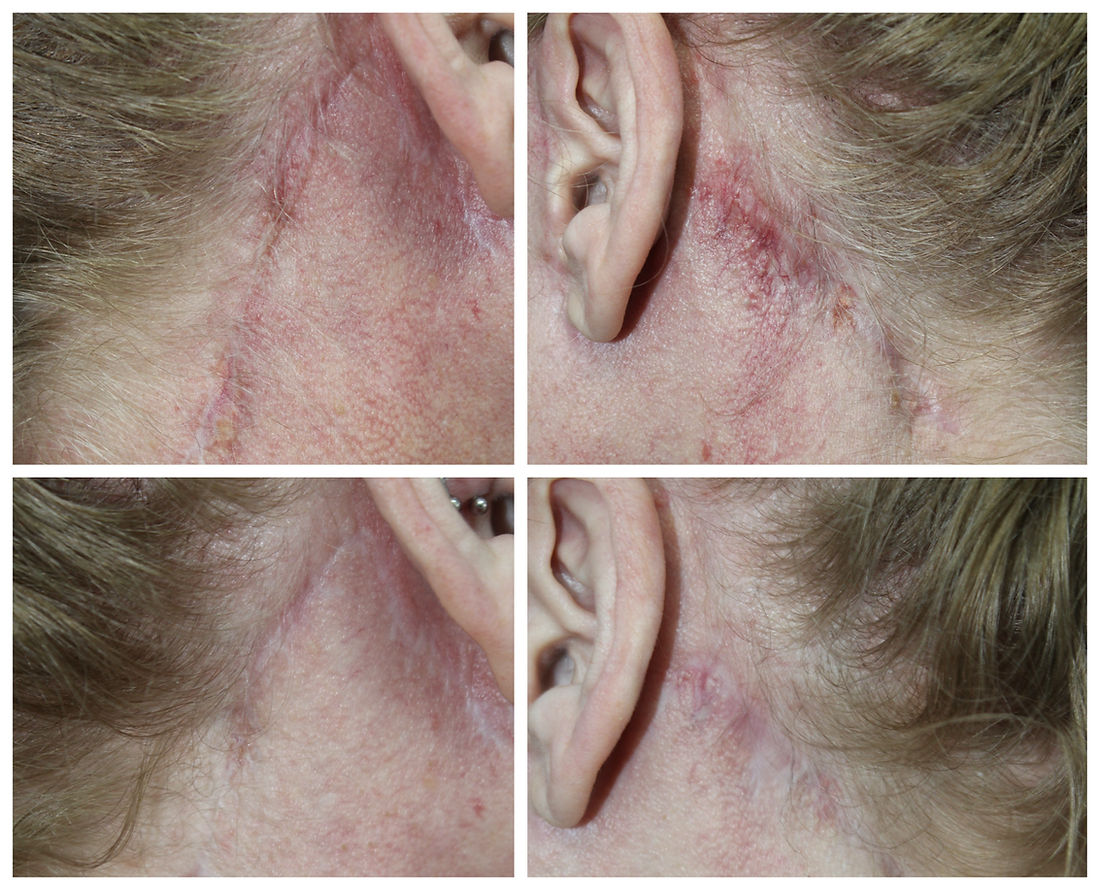
Post facelift Scar improvement
hypertrophic scars with redness. Scar improvement with combination lasers
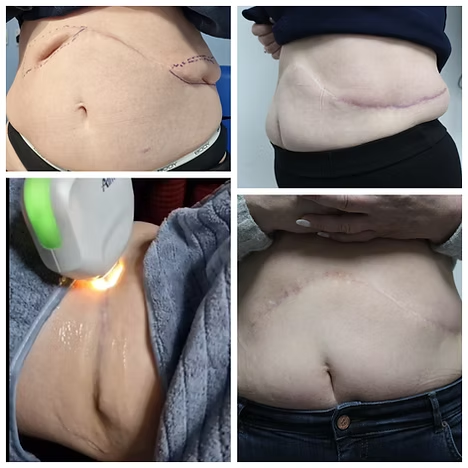
Abdominal scar correction
unsightly scar after tumor excision. Scar revision and laser to improve red lumpy scar

Post-Surgical Scar Improvement
Post Blepharoplasty Surgical depressed scars above eyebrows. Scar improvement with multi-modality treatments including Lasers, PRF and skin booster
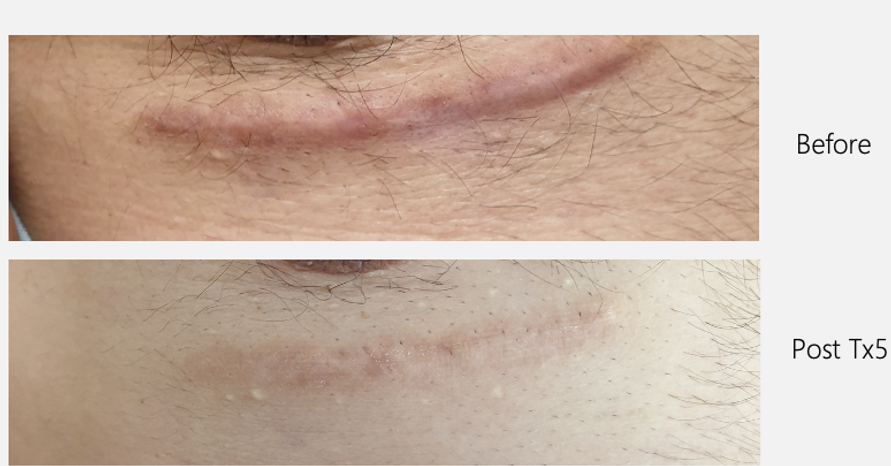
Laser Scar Treatment
Cesarean scar improvement with CO2 laser
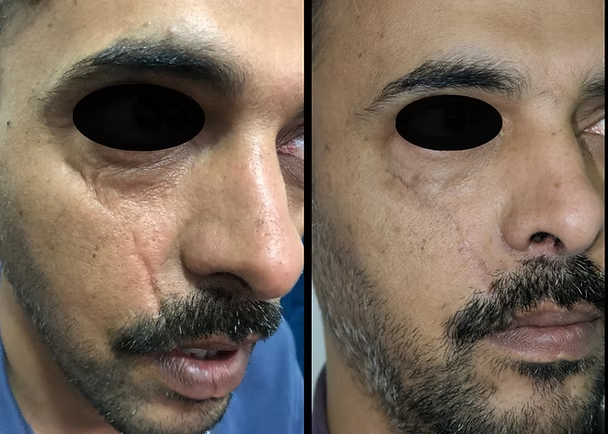
Post Traumatic Surgical Scar
A gentleman with longstanding depressed linear traumatic scar. Multiple sessions of laser including CO2 laser, 1540nm laser, 1064nm laser and PRF
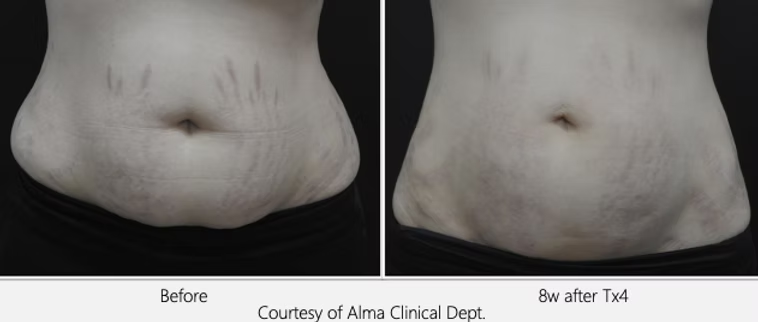
Stretch Marks Treatment
Improvement of Striae and stretch marks .
Frequently Asked Questions
Disclaimer
Skin & Scar Care Clinic provides medical-grade scar improvement treatments using advanced technologies and evidence-based techniques.
We guarantee our clinical expertise, careful assessment, and best efforts. However, individual results vary and specific outcomes cannot be guaranteed.
Scar treatment is a gradual process and usually requires multiple sessions. Scars cannot usually be completely removed, but they can often be significantly improved.
Results may vary depending on age, skin type, ethnicity, scar type, scar age, genetics, medical history, lifestyle, sun exposure, and aftercare compliance.
Patients with darker skin types may be at increased risk of post-inflammatory hyperpigmentation and may require a more cautious, staged approach.
A consultation is required before treatment to assess suitability, risks, expected outcomes, and the most appropriate treatment plan.
Following a recent consultation with Mr Salahuddin to discuss various aesthetic treatments, including ebrium laser, c02 laser and endolift. I had my first session of ebrium laser treatment today. I can honestly say Mr Salahuddin's approach is excellent! He was very informative and went into great detail about each treatment, whilst remaining courteous, honest and professional at all times. We worked out a plan 'together' and he helped with any concerns I had. I am excited to start my journey with him and I have more than 100% faith in his ability as a medical professional to give me the results I want to achieve. I would highly recommend Mr Salahuddin, his expertise is second to none.
Joan Loudon