

I would like to express my sincere gratitude to the doctor for such a professional and high-quality treatment. I came to the clinic with a large, raised, and painful viral wart on my finger. During my very first appointment, the doctor used two removal methods — laser treatment and resurfacing. Just 5 days later, there was almost no trace of the wart left. I was truly impressed by the doctor’s expertise, attention to detail, and the clinic’s advanced, high-quality equipment. Everything was done carefully, professionally, and as comfortably as possible. I highly recommend this specialist and clinic!
Ольга КостенкоI came to Skin & Scar to remove a small cyst. Dr Omer talked me through what to expect with the procedure & how to care following, putting my mind at ease. So I decided to also do something about the many moles (side effect from living in warmer climate as a child), skin tags and various older scars due to numerous past surgeries. I’m so glad I did! I’d been self conscious for too long. Dr Omer uses state of the art laser technology, of which he is has plenty and is an expert in using. I couldn’t recommend him highly enough.
Sally WhartonI had a wonderful experience at the Skin & Scar Care Clinic. The doctor took the time to carefully consult with me, discuss my skin concerns, and explain the best possible treatment for my situation. He examined my skin thoroughly and considered my rosacea, and my skin type before recommending Bio Remodelling / Bio Stimulator injections. He was extremely kind, professional, and gentlemanly, and made me feel very comfortable. He was also friendly, understanding, and considerate, which I truly appreciated. The discussion was handled in a very respectful and supportive way. The entire procedure was amazing and felt very different from my previous aesthetic clinic experiences. I felt genuinely cared for, and the doctor truly wanted me to be happy with the outcome. I am very happy with my experience and hopeful for great results.
DarwanBenign skin lesions are extremely common. Many people develop small skin tags, viral warts, brown age spots, seborrhoeic keratoses ( ageing /wisdom spots ) or DPN dermatosis papulosa nigra (dark rounded spots) over time. These lesions are usually harmless, but they can be cosmetically noticeable, irritating, rough, raised, itchy, catching on clothing, or affecting confidence.
At Skin and Scar Care Clinic, we offer careful assessment and treatment of suitable benign skin lesions using medical-grade technology, with particular emphasis on laser-based treatment for precise, controlled and natural-looking results.
Treatment options may include:
- CO₂ laser
- Erbium laser
- Nd laser
- Cryotherapy
- Curettage
- Electrocautery / electrodessication
- Combination treatment
- Skincare and sun protection advice
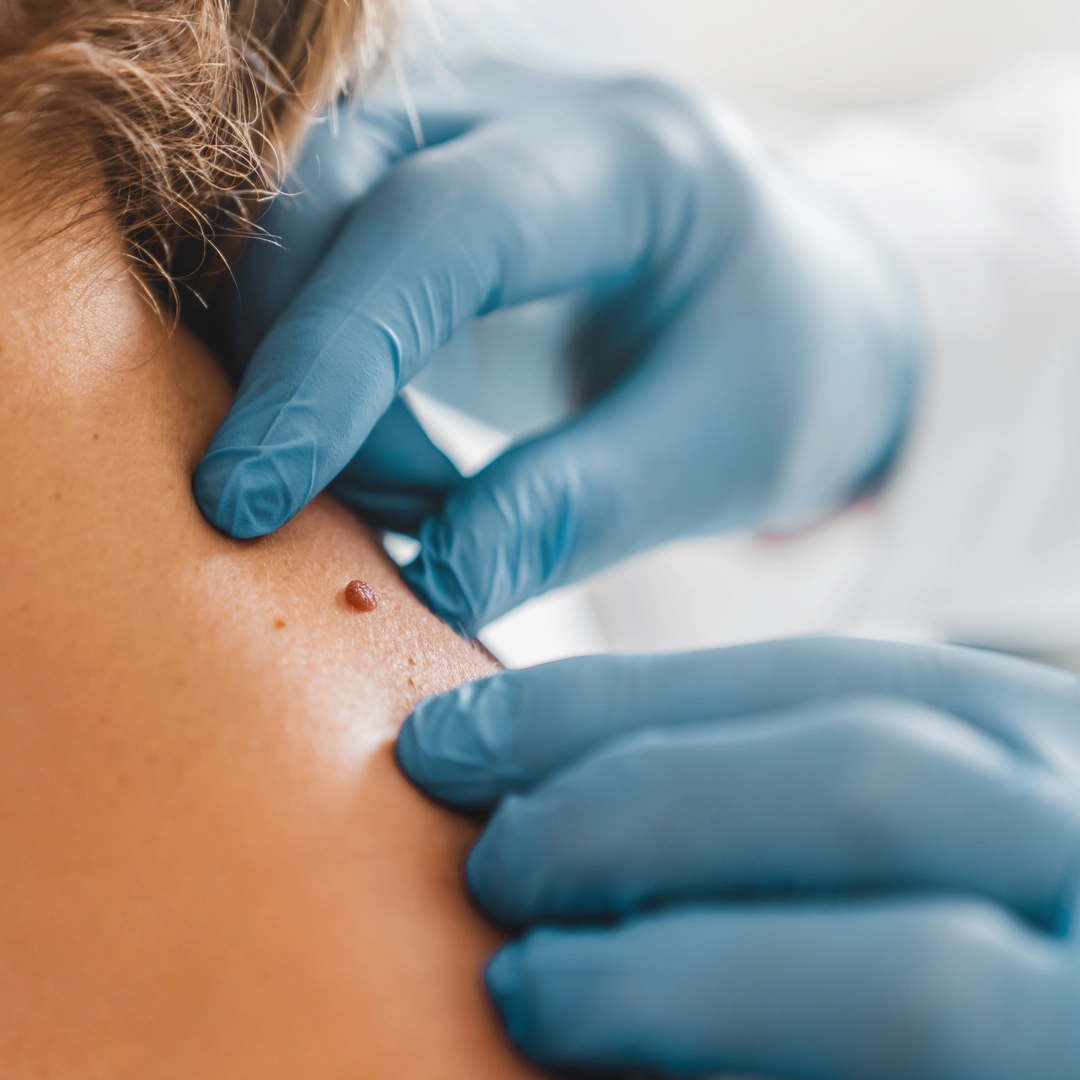
Not every brown mark or raised lesion is suitable for cosmetic removal. Any lesion that is changing, bleeding, irregular, painful, rapidly growing, crusting, ulcerated or diagnostically uncertain must be assessed medically before treatment. Safety and correct diagnosis always come first.
What Are Benign Skin Lesions?
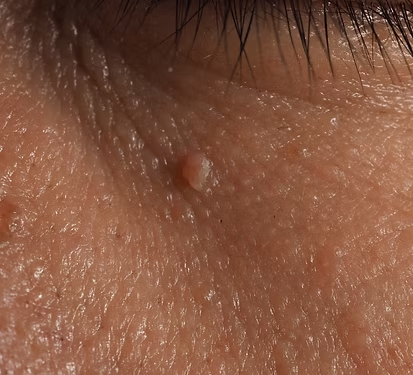
Benign skin lesions are non-cancerous skin growths or marks. They may be flat, raised, brown, skin-coloured, rough, soft, firm or wart-like.
Common benign lesions include:
- Skin tags
- Viral warts
- Seborrhoeic keratoses
- Brown sun spots / age spots / wisdom spots
- Dermatosis papulosa nigra, also known as DPN
- Some benign pigmentation patches
- Small harmless raised growths
Although many of these lesions are harmless, they can sometimes look similar to other skin conditions. This is why proper assessment is important before laser removal.
Why Diagnosis Matters Before Treatment
Before treating any lesion, we must be confident it is benign. Aesthetic removal should not be performed on a suspicious lesion. Some skin cancers or pre-cancerous lesions can mimic harmless brown spots or rough growths.
You should seek medical assessment before removal if a lesion is:
- Changing in size, shape or colour
- Bleeding
- Crusting repeatedly
- Painful
- Ulcerated
- Very dark or irregular
- Growing quickly
- Different from your other marks
- New and unusual
- Not clearly diagnosed
- Returning after previous removal
If there is any doubt, we may recommend GP, dermatology review, dermoscopy and biopsy before treatment.
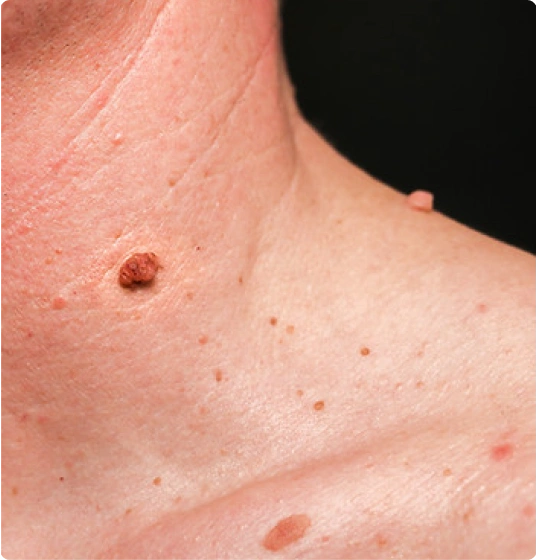
Skin Tags
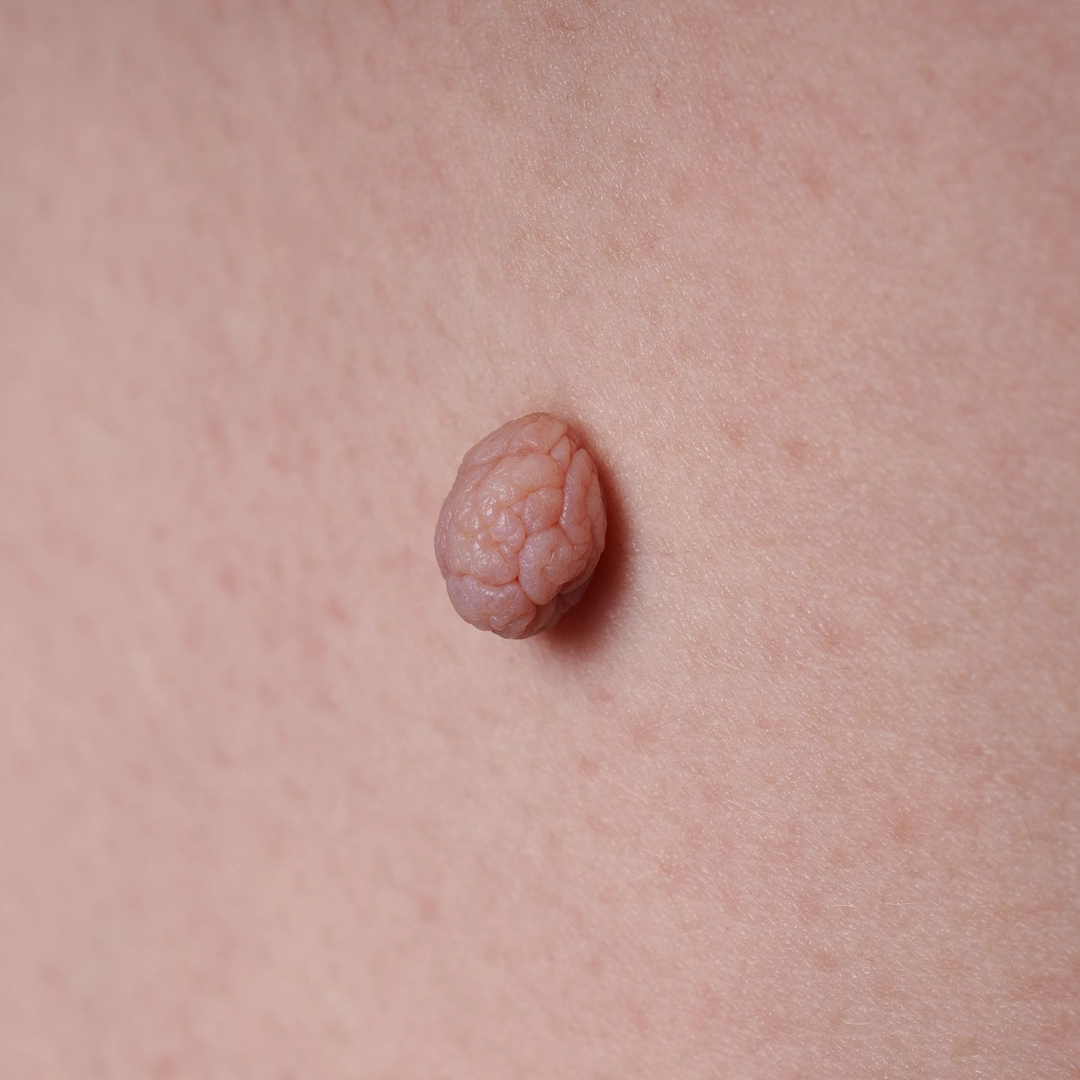
Skin tags are soft, small, skin-coloured or brown growths that often appear in areas of friction. They are common around the neck, underarms, eyelids, under the breasts and groin folds.
They may be associated with:
- Skin friction
- Ageing
- Genetics
- Pregnancy
- Weight changes
- Insulin resistance or metabolic tendency in some people
- Areas where jewellery, collars or clothing rub the skin
Skin tags are usually harmless but may become irritated, twisted, sore or cosmetically unwanted.
Skin Tag Removal
Skin tags are usually quick to remove. Depending on the size and location, treatment may involve CO₂ laser, cautery, snip removal, cryotherapy or a combination approach.
Best suited treatments
- CO₂ laser
- Electrocautery
- Snip removal
- Cryotherapy in selected cases
Benefits
- Quick treatment
- Usually minimal downtime
- Can treat multiple tags in one session
- Helps reduce catching, rubbing and irritation
- Good cosmetic result when performed carefully
Small scabs may form after treatment and usually fall away as the area heals.
Viral Warts
Viral warts are caused by the human papillomavirus, also known as HPV. They can spread through direct contact or through small breaks in the skin.
Warts may appear as:
- Rough raised bumps
- Flat warts on the face
- Finger warts
- Plantar warts on the feet
- Clusters of small warts
- Thickened painful lesions on pressure areas
Warts can be stubborn because the virus lives in the skin. Treatment aims to remove visible wart tissue and stimulate clearance, but recurrence can occur.
Viral Wart Treatment
Viral warts can be more stubborn than simple skin tags because they are caused by a virus in the skin.
Treatment may include:
- Cryotherapy
- CO₂ laser
- Nd or vascular laser approach in selected cases
- Salicylic acid advice where appropriate
- Immune-stimulating approaches in resistant cases
- Combination treatment
Why warts often need repeated treatment
Warts can regrow if viral tissue remains. They may also spread to nearby skin. For this reason, a course of treatment is often needed.
Benefits of laser wart treatment
- Useful for resistant warts
- Can target thicker wart tissue
- May be helpful where pharmacy treatment has failed
- Can be combined with other treatment methods
- Allows precise treatment in selected areas
Face warts and sensitive-area warts should always be professionally assessed before treatment
Seborrhoeic Keratosis
Seborrhoeic keratosis is a very common benign skin growth. It may look waxy, rough, stuck-on, brown, black, grey or skin-coloured. Brown spots are often caused by long-term sun exposure and ageing. They are sometimes called age spots, liver spots, sun spots or wisdom spots.
Patients often describe them as:
- Waxy growths
- Rough brown patches
- Stuck-on lesions
- Raised age spots
- Crusty wisdom spots
- Wart-like brown growths
Seborrhoeic keratoses are harmless, but they can become itchy, irritated, inflamed, caught on clothing, or cosmetically noticeable.
Seborrhoeic Keratosis Removal
Seborrhoeic keratoses can be flat, raised, rough, waxy or crusted. They are benign but can look very noticeable, especially when they appear on the face, neck, chest, back or under the breast area.
Treatment may include:
- CO₂ laser
- Erbium laser
- Cryotherapy
- Curettage
- Electrocautery
- Shave removal in selected cases
Benefits of laser treatment for seborrhoeic keratosis
- Precise removal of raised tissue
- Useful for rough, thick or stuck-on lesions
- Can smooth the surface
- Can treat multiple small lesions
- Good cosmetic potential
- Controlled treatment depth
Some lesions clear in one session. Thicker or multiple lesions may require more than one treatment.
Dermatosis Papulosa Nigra, also known as DPN
DPN causes multiple small, dark, raised papules, most commonly on the face, cheeks, temples, neck and upper chest. It is more common in darker skin types and often runs in families.
DPN lesions are benign, but many patients choose treatment because they become more numerous, darker or more raised with age.
DPN treatment requires particular care because darker skin types have a higher risk of pigmentation changes after aggressive treatment.
DPN Removal
DPN commonly appears as multiple small, dark bumps on the face, especially around the cheeks, temples and eyes. It is more common in darker skin types and often increases with age.
Treatment may include:
- CO₂ laser
- Nd laser in selected cases
- Electrodessication
- Curettage
- Very cautious cryotherapy in selected cases
Why DPN needs careful treatment
DPN often occurs in skin types that are more prone to post-inflammatory hyperpigmentation or hypopigmentation. This means treatment must be superficial, controlled and tailored.
Benefits
- Improves the appearance of multiple small dark bumps
- Helps smooth the skin surface
- Can treat several lesions in one visit
- Supports clearer-looking skin
- Good cosmetic improvement when performed carefully
A test patch may be recommended, especially in darker skin tones or when treating the face
Treatment Options
CO₂ Laser
CO₂ laser is one of the most useful treatments for suitable raised benign lesions. It works by precisely vaporising unwanted tissue layer by layer.
CO₂ laser may be used for:
- Skin tags
- Seborrhoeic keratosis
- Selected DPN lesions
- Some raised benign lesions
- viral warts
- Thick or rough surface lesions
Benefits of CO₂ Laser
CO₂ laser allows controlled removal with precision without cuts, stitches or bleeding. It can be useful where the lesion is raised, rough, thick or stuck-on.
Benefits may include:
- Precise treatment
- Controlled removal of raised tissue
- Minimal damage to surrounding skin when used carefully
- Useful for multiple small lesions
- Good cosmetic potential
- Can treat difficult textured lesions
- Can be combined with other methods
CO₂ laser is particularly useful for raised lesions such as seborrhoeic keratoses, skin tags and selected DPN lesions.
Nd YAG Laser
Long Pulse Nd laser may be used for selected pigmentation and vascular-related components, depending on the lesion type and skin tone.
In selected cases, Nd laser may be considered for:
- Some deeper vascular components
- Resistant warts to reduce the blood supply at the base of the wart
- Darker skin types where careful settings are required
Nd laser treatment must be planned carefully, especially in darker skin tones, to reduce the risk of pigmentation change.
Cryotherapy
Cryotherapy uses controlled freezing to destroy selected superficial skin lesions.
It may be used for:
- Viral warts
- Some seborrhoeic keratoses
- Some skin tags
- Selected superficial benign lesions
Cryotherapy may cause blistering, crusting, redness, tenderness, pigmentation change or scabbing before healing. It is used cautiously in darker skin types due to the risk of lighter or darker marks after treatment.
Curettage
Curettage involves gently scraping or shaving the lesion away using a sterile instrument, sometimes after local anaesthetic.
It may be used for:
- Seborrhoeic keratoses
- Some raised benign lesions
- Selected DPN
- Lesions that need physical removal
- Curettage may be combined with cautery or laser depending on the lesion.
Electrocautery / Electrodessication
Electrocautery uses controlled heat energy to remove or dry out selected superficial lesions.
It may be used for:
- Skin tags
- DPN
- Small seborrhoeic keratoses
- Small benign raised lesions
It must be used carefully to reduce the risk of scarring or pigmentation changes.
Treatment Timeline
Step 1: Consultation and Lesion Assessment
Before treatment, your practitioner will assess:
- Lesion type
- Size and depth
- Colour
- Surface texture
- Location
- Number of lesions
- Skin type
- Pigmentation risk
- Medical history
- Previous treatments
- Whether the lesion looks clearly benign
If a lesion is suspicious or uncertain, we may recommend medical review or biopsy before cosmetic treatment.
Step 2: Test Patch if Required
A test patch may be advised for:
- Darker skin types
- Multiple DPN lesions
- Pigment laser treatment
- Sensitive facial areas
- Uncertain healing response
- Patients prone to pigmentation changes
This helps assess how the skin responds before treating larger areas.
Step 3: Treatment Session
Treatment time depends on the number and type of lesions.
Small skin tags or individual lesions may take only a short time. Multiple DPN lesions, wart treatment or extensive pigmentation may take longer.
A topical numbing cream or local anaesthetic may be used depending on the procedure.
Step 4: Healing Phase
After treatment, the area may become:
- Red
- Slightly swollen
- Tender
- Dry
- Crusted
- Scabbed
- Temporarily darker
- Temporarily lighter
Scabs should not be picked. The area should be kept clean and protected while healing.
Typical healing time:
- Small skin tags: around 5–10 days
- Small DPN lesions: around 7–14 days
- Seborrhoeic keratosis: around 1–3 weeks depending on size
- Warts: variable, often needing repeated sessions
- Pigment treatment: darkening and flaking may occur over 1–2 weeks
Healing varies from person to person.
Step 5: Review and Further Treatment
Some lesions may need more than one session.
Typical treatment courses:
- Skin tags: often 1 session
- Seborrhoeic keratosis: often 1 session, sometimes more for thicker lesions
- DPN: 1–3 sessions depending on number and skin response
- Brown spots: 1–4 sessions depending on depth and recurrence
- Viral warts: often 3–6 sessions, sometimes more if resistant
Maintenance and Prevention
Not all lesions can be prevented. Some people naturally develop more skin tags, DPN or seborrhoeic keratoses with age or genetics.
Maintenance may include:
- Daily SPF 30–50
- Avoiding tanning beds
- Reducing friction where skin tags occur
- Avoiding picking lesions
- Early review of new or changing lesions
- Periodic top-up treatment if new lesions develop
- Skincare to support pigmentation control
- Follow-up for recurrent warts
Sun protection is especially important for brown spots and pigmentation-prone skin.
What Results Can You Expect?
Results depend on the type, number, size and depth of lesions.
Treatment may help:
- Remove unwanted raised lesions
- Improve skin smoothness
- Reduce irritation from catching or rubbing
- Improve appearance of brown spots
- Reduce visible DPN bumps
- Improve cosmetic confidence
- Treat resistant or uncomfortable warts
- Create a clearer-looking complexion
No treatment can guarantee that new lesions will not develop in future.
Before & After


During my very first appointment, the doctor used two removal methods — laser treatment and resurfacing.
Just 5 days later, there was almost no trace of the wart left.

Frequently Asked Questions
Skin tags are usually harmless. However, any lesion that is changing, bleeding, painful, irregular or uncertain should be assessed before removal.
Yes. CO₂ laser can be used to remove suitable skin tags precisely. Other options include cautery, snip removal or cryotherapy.
The treated skin tag usually does not return if fully removed, but new skin tags may develop in other areas over time.
Yes. Viral warts are caused by HPV and can spread through direct contact or small breaks in the skin.
Yes. CO₂ laser or selected vascular laser approaches may be used for resistant warts. Warts often need multiple sessions because they are viral and can recur.
It is safer to have facial warts assessed professionally. Pharmacy wart treatments may irritate facial skin and are not always suitable for the face.
Age spots, also called sun spots or wisdom spots, are flat brown marks caused mainly by long-term sun exposure and ageing.
Many benign brown spots can be improved with pigment laser, DPL / IPL-type treatment, chemical peels or medical skincare. Diagnosis must be confirmed first.
No. Many brown spots are harmless, but some suspicious pigmented lesions can resemble benign marks. Any changing or irregular lesion should be medically assessed.
Seborrhoeic keratosis is a common benign skin growth that often looks waxy, rough or stuck-on. It can be brown, black, grey or skin-coloured.
Yes. CO₂ laser or Erbium laser may be used for suitable seborrhoeic keratoses. Other options include cryotherapy, curettage or cautery.
A treated lesion may clear, but new seborrhoeic keratoses can develop over time because they are linked to age and genetics.
DPN stands for dermatosis papulosa nigra. It causes small dark raised bumps, commonly on the face and neck, especially in darker skin types.
Yes, DPN can often be improved safely, but treatment must be gentle and carefully planned to reduce the risk of pigmentation changes.
Laser can be suitable for darker skin tones, but the settings and treatment method must be chosen carefully. A test patch may be recommended.
Most treatments aim to minimise scarring, but any procedure that removes or damages skin carries some risk of scarring, pigmentation change or incomplete healing.
Most treatments are well tolerated. Some patients feel heat, stinging or mild discomfort. Numbing cream or local anaesthetic may be used when needed.
It depends on the lesion. Skin tags and some seborrhoeic keratoses may need one session. Warts, DPN and pigmentation may require multiple sessions.
Sometimes, yes. However, if there are many lesions, darker skin tone, uncertain diagnosis or higher risk of pigmentation change, staged treatment may be safer.
If a lesion is suspicious, changing, irregular or uncertain, biopsy or dermatology review may be recommended before removal.
You may need to avoid makeup until the treated area has healed, especially if there is crusting or broken skin. Your practitioner will advise you.
Aftercare usually includes keeping the area clean, avoiding picking, using recommended ointment, avoiding harsh skincare and protecting the area from sun exposure.
Yes. Temporary or sometimes longer-lasting pigmentation changes can occur, especially in darker skin tones or after aggressive treatment. This is why careful settings and SPF are important.
Safety and Medical Disclaimer
The information on this page is for general educational purposes and does not replace a medical consultation.
All skin lesion treatments are subject to consultation, assessment, suitability and informed consent. Treatment will only be offered when the lesion appears suitable for aesthetic removal.
Laser or cosmetic treatment should not be used on suspicious, changing or undiagnosed pigmented lesions. If there is any concern about skin cancer, pre-cancerous change or uncertain diagnosis, medical assessment, dermoscopy, biopsy or referral may be required before treatment.
Possible side effects of treatment include redness, swelling, tenderness, bruising, blistering, crusting, scabbing, infection, delayed healing, burns, pigmentation changes, hypopigmentation, hyperpigmentation, scarring, incomplete removal, recurrence or the development of new lesions.
Patients with darker skin tones may have a higher risk of post-inflammatory pigmentation changes and may require test patching, lower settings or staged treatment.
Viral warts may recur after treatment because HPV can remain in the surrounding skin. Brown spots may also recur or new pigmentation may develop, especially with ongoing sun exposure.
No treatment outcome can be guaranteed. Results vary depending on lesion type, size, depth, location, skin tone, healing response, medical history and aftercare compliance.
Following a recent consultation with Mr Salahuddin to discuss various aesthetic treatments, including ebrium laser, c02 laser and endolift. I had my first session of ebrium laser treatment today. I can honestly say Mr Salahuddin's approach is excellent! He was very informative and went into great detail about each treatment, whilst remaining courteous, honest and professional at all times. We worked out a plan 'together' and he helped with any concerns I had. I am excited to start my journey with him and I have more than 100% faith in his ability as a medical professional to give me the results I want to achieve. I would highly recommend Mr Salahuddin, his expertise is second to none.
Joan Loudon